
Decentralized cloud storage
The cloud is badly named. Files do not float somewhere above us; they sit on physical machines owned by companies such as Amazon, Microsoft and Google.
For most users, this arrangement works remarkably well. A photograph uploaded in Paris can be retrieved seconds later in Amsterdam, while the owner remains largely unaware of the data centres, replication systems and storage protocols making this possible. The convenience is real. So is the concentration of control.
An application may run open-source software, use a decentralised blockchain and present itself as part of a new digital economy, yet still depend on one cloud provider to store its files. If that provider changes its prices, restricts access or suffers an outage, the supposedly decentralised application discovers that part of its infrastructure was never particularly decentralised.
Hippius, Bittensor Subnet 75, is trying to build an alternative. It coordinates a distributed network of storage providers, allowing users and applications to store encrypted files across independently operated machines rather than placing everything inside one company’s infrastructure.
Its role inside Bittensor is relatively easy to picture. If compute gives the network processing power and inference gives it access to models, Hippius is attempting to provide somewhere for the resulting data to live.
What problem does Hippius solve?
Almost every digital system depends on storage. Websites need databases and media files. Businesses need backups and documents. AI models require datasets, checkpoints, embeddings, logs and generated outputs. Agents need persistent information if they are expected to remember anything after a session ends.
Most of this data currently resides inside centralised clouds. These platforms have become dominant for good reasons: they are reliable, globally accessible and relatively simple to use. Developers can rent storage without buying hardware or maintaining their own server rooms, an arrangement that has spared many small companies from becoming reluctant data-centre operators.
The trade-off is dependence. The provider controls the physical infrastructure, defines the pricing and determines which services or jurisdictions it will support. It also becomes a concentrated point of operational and political power. A single provider failure can affect thousands of otherwise unrelated applications, while a policy decision made by one company can remove access for an entire category of users.
Decentralised storage distributes that dependence across multiple operators. Instead of trusting one company to keep a complete file available, the system divides responsibility among independent nodes and uses cryptography and redundancy to make the data recoverable when some of those nodes disappear.
This is the problem Hippius is designed to address. The project is attempting to offer the resilience and openness of distributed infrastructure while retaining enough of the normal cloud experience that developers can use it without first developing an unusual enthusiasm for storage protocols.
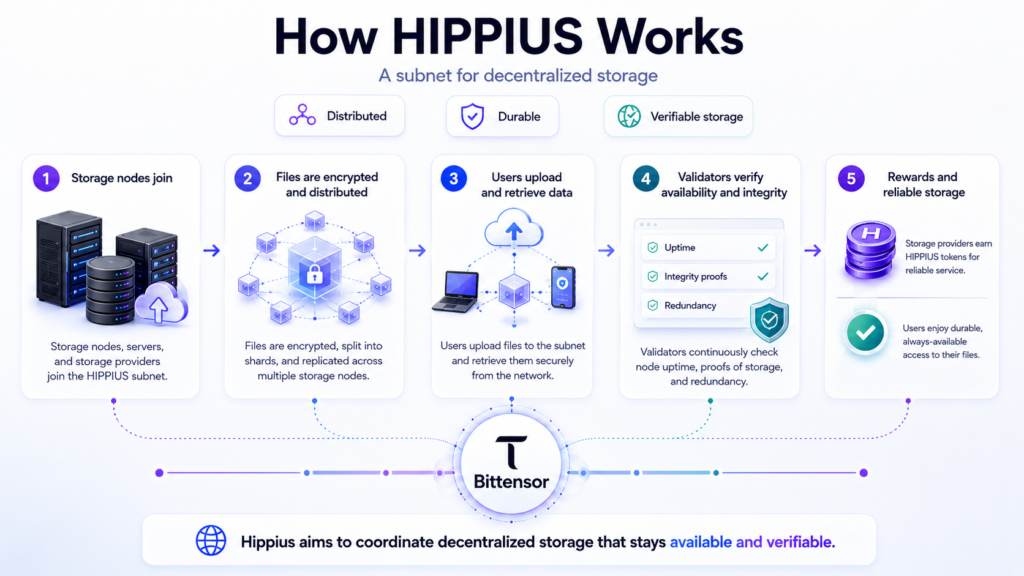
How Hippius stores a file
According to the Hippius documentation, files are encrypted, divided into shards and distributed across independent miners. The system uses Reed–Solomon erasure coding, a method that adds redundancy without requiring every storage provider to hold a complete copy of the file.
Hippius describes a structure in which each file is divided into 30 shards. Any 10 of those shards are sufficient to reconstruct the original data. In principle, this allows the file to remain recoverable even if as many as 20 miners become unavailable at the same time.
The basic logic is similar to distributing pieces of a document across many locked boxes, while designing the pieces so that only a subset is needed to rebuild the whole. No individual storage miner needs to possess the complete file, and the loss of several boxes does not automatically destroy the document.
Encryption adds another layer. The Hippius materials state that miners store encrypted bytes rather than readable user files. This reduces the need to trust each storage operator with the contents of the data, although the strength of that protection still depends on implementation details such as encryption methods, key management and the security of the user’s device. Decentralisation can distribute risk; it does not repeal cryptography’s habit of caring about details.
When a user later requests the file, the system locates enough available shards, retrieves them and reconstructs the original data. Validators and the Hippius infrastructure track whether miners are storing the assigned information and remaining available to serve it.
From the user’s perspective, the intended experience is much simpler than the mechanism underneath it. A file is uploaded, stored and retrieved. The encryption, distribution and verification should happen in the background.
That distinction matters. A decentralised storage network can be technically elegant and still remain commercially irrelevant if using it feels like operating laboratory equipment.
Why build this on Bittensor?
Storage is an unusually concrete digital commodity. A miner either provides the promised capacity or it does not. The assigned data remains available or disappears. Retrieval is fast enough for the intended application or it is not. Integrity checks can determine whether the stored shards remain unchanged.
These properties make storage a natural candidate for an incentive market.
In Hippius, miners contribute disk space and the infrastructure required to serve data. Validators assess their performance and help determine which participants receive rewards. Bittensor supplies the economic coordination layer: independent operators can join the network, compete to provide useful storage and earn according to the value the subnet assigns to their service.
A conventional cloud provider owns or leases the underlying facilities and manages capacity through one corporate system. Hippius is exploring whether the same basic service can emerge from a network whose infrastructure is supplied by many separate participants.
The incentive mechanism is central because unused storage capacity has little value on its own. A collection of hard drives scattered across the world does not automatically become a cloud. The network needs rules for assigning data, checking that miners still possess it, measuring retrieval performance, replacing unreliable nodes and rewarding operators who provide dependable service.
Bittensor gives Hippius a way to coordinate those behaviours without employing every storage provider directly. If the scoring system rewards the correct qualities, miners have an economic reason to increase capacity and maintain reliable infrastructure. If it rewards the wrong proxy, they will optimise for the proxy instead. Hard drives are obedient creatures in that regard; they follow the incentives of their owners.
The quality of Hippius therefore depends on more than the amount of storage connected to the subnet. It depends on whether the incentive mechanism can turn that capacity into a service people can trust.
From storage network to usable cloud
The decentralised storage sector is not empty. Several networks already allow users to distribute data across independent providers, and some have been operating for years. Hippius cannot succeed merely by proving that files can be divided and stored across multiple machines.
Its more interesting objective is to make the resulting infrastructure resemble a conventional cloud product.
The team describes Hippius as distributed S3 storage. S3 is the object-storage interface popularised by Amazon Web Services and widely used by developers. Compatibility with this standard matters because applications already understand how to interact with it. A developer can connect existing software to an S3-compatible service without redesigning the entire application around a new storage protocol.
Hippius also presents Arion as a product designed for fast file access, using deterministic routing and self-healing mechanisms to locate data and replace unavailable storage. Alongside this, the project offers interfaces such as a console, desktop application and API.
These product layers are more important than they may initially appear. The protocol can distribute and verify storage, but customers purchase an experience: files should upload reliably, appear where expected and return quickly when requested. They do not generally wish to celebrate successful shard reconstruction before opening a spreadsheet.
Hippius is also positioning storage as one part of a broader cloud platform that may include virtual machines and applications. Users are intended to select services through a single interface and pay according to usage, with payment options that can bridge conventional users and the Bittensor economy.
If that experience becomes competitive, Hippius could give developers access to decentralised infrastructure without requiring them to become specialists in either blockchains or distributed storage. That would be a meaningful achievement. Much of the decentralised technology industry has spent years building products that are theoretically accessible to everyone and practically accessible to people who enjoy command-line documentation.
The price argument
The most commercially important Hippius claim may be much simpler than its distributed architecture: the team says its storage is many times cheaper than AWS and other conventional alternatives.
That deserves emphasis because decentralisation alone is rarely enough to persuade a business to move important infrastructure. Companies may appreciate open networks in principle, but purchasing decisions tend to become less philosophical when the cloud invoice arrives. If Hippius can offer reliable storage at a fraction of the cost of major cloud providers, it would have a practical advantage that extends well beyond crypto-native users.
There is a plausible structural reason why a distributed market could lower prices. Large cloud platforms include corporate overhead, substantial margins and the cost of operating an enormous integrated organisation. Hippius can potentially source capacity from independent miners competing to provide storage, including infrastructure that might otherwise remain underused.
The comparison still needs to be examined carefully. Cloud pricing is rarely one number. Storage costs, retrieval fees, outbound bandwidth, redundancy, support and performance guarantees all affect the final bill. Hippius therefore needs to demonstrate its savings through transparent, like-for-like comparisons rather than relying on an impressive headline multiple.
Even with that qualification, the price claim changes the nature of the project. Hippius is not only arguing that storage should be more decentralised. It is arguing that decentralised coordination can produce the service more efficiently.
If the network can combine meaningfully lower prices with sufficient reliability, Hippius would not need customers to adopt it as an ideological favour. The economics could make the decision for them.
Why decentralised AI needs storage
Hippius becomes more interesting when considered as part of a wider Bittensor infrastructure stack.
Bittensor is often introduced as a network for producing machine intelligence, but useful AI systems require more than models. A model needs compute to run, networking to receive requests, memory to retain context and storage for the files and data surrounding the application.
Consider an AI agent that works with a company’s internal documents. The model may be served through a decentralised inference subnet, while confidential compute protects the processing environment. Yet the documents, vector database, conversation history and generated reports still need to be stored somewhere. If all of that remains inside one conventional cloud account, only part of the system has moved onto open infrastructure.
Hippius is attempting to fill this missing layer. Its miners can provide storage for datasets, model outputs, application files, backups and the persistent information used by AI agents. Other Bittensor subnets could theoretically use the service without building their own storage network from scratch.
This creates the possibility of a more integrated decentralised cloud. Compute might come from one subnet, inference from another and storage from Hippius, with applications combining those resources behind a normal interface.
That architecture is still emerging rather than complete. Separate subnets do not automatically become a coherent platform simply because they share Bittensor’s economic layer. They need compatible interfaces, predictable pricing and reliable performance. Developers care less about ecosystem diagrams than whether the components work together on Tuesday morning.
Hippius nevertheless represents an important direction. It treats Bittensor as a coordination network for digital infrastructure rather than limiting it to model competitions and benchmark performance.
The central challenge: earning trust
I think Hippius’s greatest challenge is trust.
The project is still young, while the data people place into storage systems may be among their most important digital possessions. Family photographs, company documents, research datasets, backups and private records are not experimental assets. Losing access to them can create damage that no attractive storage discount can compensate for.
The technical design sounds reassuring. Files are encrypted, split across miners and protected through redundancy. Yet most users, myself included, will need more than an explanation of the architecture before placing irreplaceable data on the network. We need confidence that the system has operated reliably over time, that recovery works under real failure conditions and that the organisation behind the product can respond when something goes wrong.
This creates an unavoidable asymmetry. Hippius may work perfectly for thousands of uploads, but one serious data-loss event could damage trust far more than those successful uploads build it. Storage infrastructure is judged less by what happens during normal operation than by what happens on the worst day.
The project will therefore need evidence rather than promises: public reliability statistics, independent security reviews, clear recovery procedures, transparent incident reporting and a long operating history. Customers may begin with replaceable files or secondary backups before trusting the system with primary copies of valuable data. That gradual process is reasonable. Trust in storage is accumulated slowly and can be deleted rather more efficiently than the files themselves.
Reliability also requires continuous maintenance. Hippius must detect missing shards and restore redundancy before additional miner failures make data unrecoverable. Retrieval performance must remain suitable for the promised use case, while encryption keys must be protected and recoverable without creating a central security weakness.
The low-price claim makes Hippius attractive enough to investigate. Its ability to earn durable trust will determine whether people actually stay.
Why this subnet is interesting
Hippius is one of the clearer examples of Bittensor expanding beyond the production of narrowly defined AI outputs.
The resource being coordinated is understandable: storage capacity. The suppliers are visible: miners operating disks and servers. The quality criteria can be tested through availability, integrity and retrieval. External customers can pay for a service that already has an established global market.
Hippius also makes a commercially ambitious claim. If it can provide storage many times more cheaply than AWS and other alternatives, the subnet could compete on economics rather than relying on decentralisation as its only selling point. That is a much stronger proposition.
It does not make the project easy. Centralised cloud storage is mature and deeply embedded in modern software. Existing decentralised networks also compete for many of the same users. More importantly, established providers have spent years earning confidence that stored data will remain available. Hippius must compress part of that trust-building process without taking shortcuts.
What makes the subnet worth following is its position inside the wider Bittensor architecture. If other subnets begin producing commercially useful models, agents and applications, they will need dependable infrastructure around them. Storage is among the least glamorous parts of that stack, which is usually a sign that someone will eventually need to take it seriously.
Hippius is trying to turn independently owned storage capacity into a shared cloud service that is open, inexpensive and coordinated through Bittensor.
The price may persuade people to try it. Reliability will determine whether they entrust it with anything that matters.