
A Decentralized Marketplace for Creator Marketing
The simple idea
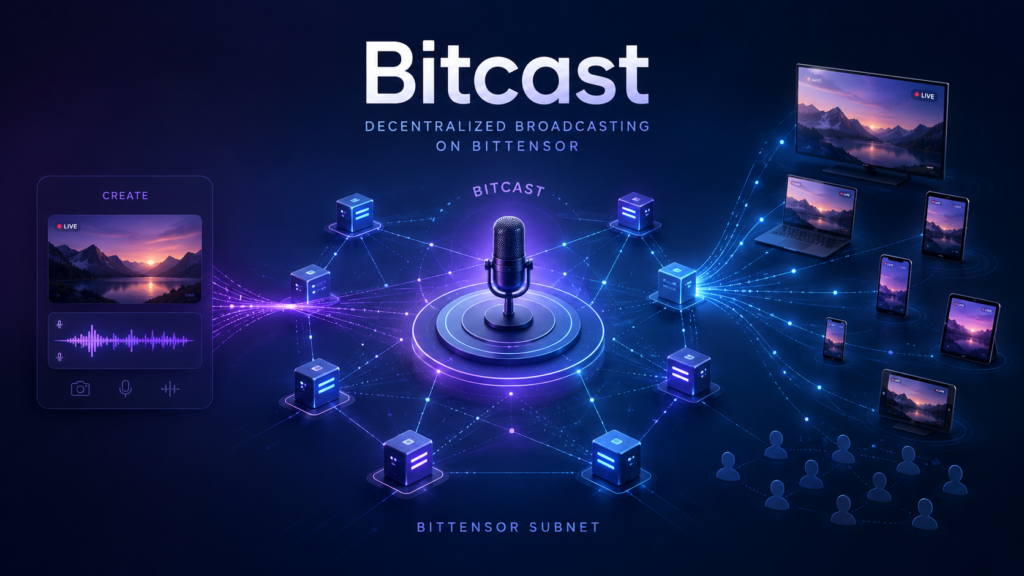
Bitcast is building a marketplace where brands can pay online creators to produce content about their products, while software automatically checks whether the content followed the instructions and how much genuine attention it received.
Instead of a company manually searching for influencers, negotiating individual contracts and hoping that a campaign performs well, it can publish a campaign brief through Bitcast. Creators then choose whether they want to participate, publish qualifying content and earn rewards based on the attention their work generates.
In simple terms, Bitcast tries to turn creator marketing into an open and measurable market.
It operates as Subnet 93 on Bittensor.
What problem does this subnet solve?
Influencer and creator marketing can be surprisingly inefficient.
A company that wants YouTubers or X creators to discuss its product must normally find suitable creators, contact them individually, negotiate prices and manually check the resulting content. The company may pay a large upfront fee without knowing how many people will genuinely watch or engage with the promotion.
Follower counts do not necessarily solve this problem. A creator with 100,000 followers may generate less meaningful attention than a smaller creator with a highly engaged audience. Views can also be misleading when people immediately stop watching or when engagement has been artificially manipulated.
Creators face the opposite problem. Smaller creators may have valuable audiences but struggle to attract sponsors because brands do not know they exist. Negotiating sponsorships also takes time, and payments are often based on the creator’s perceived status rather than the measurable results of an individual piece of content.
Bitcast attempts to replace this fragmented process with a more open system. Brands define what they want, creators compete to deliver it and rewards are linked to verified performance rather than private negotiations.
What does Bitcast actually do?
Brands or projects create a brief describing the message they want creators to communicate. A brief can specify the topic, required claims, the type of content and how prominently the sponsor must appear.
Creators can then select a brief and produce qualifying content. Bitcast currently supports creator campaigns across YouTube and X, with its X-focused product operating through Stitch3. The Bitcast creator portal allows participants to view campaigns, connect their accounts, track earnings and even test a proposed script against a brief before producing the final video.
On YouTube, a campaign may request one of several formats. A dedicated video places the sponsored subject at the centre of the content. An ad read contains a separate promotional segment, while an integration weaves the sponsor into a broader video.
Validators check whether the transcript and description satisfy the campaign requirements. They also use temporary access to official YouTube Analytics data to measure performance. Rather than relying only on public view counts, Bitcast’s reward system uses signals such as estimated watch time and YouTube Premium revenue. Videos generally earn rewards during the first fourteen days after publication, with delayed measurement to give YouTube time to identify suspicious engagement.
For creators who are not yet part of YouTube’s monetisation programme, Bitcast estimates the value of their attention using minutes watched. This makes it possible for smaller channels to participate rather than restricting campaigns to already established influencers.
Stitch3 extends the same general model to X. It maps influence within particular online communities and helps projects identify creators who are genuinely relevant to a specific subject. The objective is not simply to find accounts with the largest follower numbers, but to understand which voices are recognised and amplified by other influential participants in that community.
The result is something resembling an advertising marketplace with an automatic referee. Brands provide the campaign and budget, creators produce the content, and the network measures who delivered the most valuable attention.
Why build this on Bittensor?
A conventional creator marketing platform could also build campaign software and analyse engagement. The important difference is that Bittensor allows Bitcast to create an open competition around the production and verification of attention.
The miners are not primarily operating expensive GPUs. In Bitcast, the productive participants are creators who publish content fulfilling campaign briefs. Validators inspect their work, verify the performance data and determine how rewards should be distributed.
This makes the incentive mechanism itself the central product.
A traditional marketing agency hires or contracts a limited group of creators. Bitcast can potentially attract a much larger and more varied network because anyone who satisfies the participation requirements can compete for rewards. Creators are incentivised to improve their scripts, presentation, audience targeting and distribution because better results can lead directly to higher earnings.
Bittensor also gives Bitcast a native method for paying participants across countries without building a separate international payment system. The subnet’s alpha token provides the reward layer, while Bittensor coordinates the miners, validators and emissions that keep the marketplace operating. Bittensor subnets are specifically designed as incentive-based markets in which miners produce a digital commodity and validators measure its quality. In Bitcast’s case, that commodity is measurable creator attention.
Why is this helpful?
For brands, Bitcast can make creator marketing more measurable and scalable.
Instead of negotiating separately with dozens of influencers, a brand can publish a brief and allow creators to decide whether the opportunity suits their audience. The brand can connect its spending more directly to actual content performance rather than paying entirely on the basis of reputation or follower counts.
This could be especially useful for smaller technology companies and online communities that want to reach specialised audiences. A project building developer tools, privacy technology or an AI product may not need a celebrity with millions of followers. It may be better served by twenty smaller creators whose audiences genuinely care about that subject.
For creators, Bitcast creates another route to monetisation. A relatively small channel can earn based on the attention it generates for a campaign instead of waiting until it becomes large enough to attract traditional sponsors.
It also reduces some of the administrative work. Creators can discover available briefs directly, see the requirements and participate without first convincing a marketing agency that they deserve to be included.
The broader value is better price discovery. Brands learn what real attention costs, while creators discover what their audiences are worth.
Why is this subnet interesting?
Bitcast is interesting because it demonstrates that Bittensor is not limited to conventional machine-learning tasks.
The network is being used to coordinate humans who produce a measurable digital output. AI assists with checking whether content follows a brief, but the main commodity is human-created media and the attention surrounding it.
This matters because creator marketing is usually organised through closed platforms, agencies and private relationships. Bitcast is experimenting with something more open: a market where creators can compete based on verifiable results.
It is also one of the clearer examples of a subnet connecting its service to external revenue. Bitcast’s public dashboard reported approximately $268,800 in cumulative marketing revenue by July 2026. It recorded 817 creators across YouTube and Stitch3, around $464,000 in creator rewards and a combined audience approaching 10 million followers and subscribers.
The dashboard also showed that part of the revenue had been used to acquire the SN93 subnet token. At the time of the update, roughly 610 TAO had been used for approximately 50,400 alpha-token buybacks. This creates a potential connection between commercial demand for Bitcast’s advertising services and demand for its subnet token, although the long-term economic effect will depend on the scale and consistency of that revenue.
Bitcast is therefore more than a system that pays people to mention Bittensor on YouTube. The larger ambition is to build infrastructure through which any brand can launch creator campaigns across different platforms, communities and languages.
The valuable asset may ultimately be the network’s map of attention: which creators matter within a particular community, what messages they can communicate effectively and how much measurable attention they can produce.
Beginner takeaway
Bitcast connects brands with online creators.
Brands publish campaign briefs explaining what they want promoted. Creators produce YouTube videos or X posts that satisfy those briefs. Bitcast verifies that the content follows the instructions, measures the resulting attention and uses Bittensor to reward the creators who perform best.
The simplest way to understand Bitcast is:
It is trying to make creator marketing function more like an open, measurable market and less like a collection of private deals.
Bittensor provides the competition and reward system underneath it. Creators act as miners, validators measure their work, and brands supply the external demand.
Bitcast is an interesting example of how Bittensor can coordinate not only machines producing intelligence, but also humans producing valuable digital work.
More information: https://stats.bitcast.network/revenue