
Decentralized AI Inference for Open-Source Models
An AI model can be completely open and still remain difficult to use.
The weights may be downloadable. The code may be available on GitHub. Developers may be allowed to inspect, modify and fine-tune the system. Yet someone still needs to provide GPUs, load the model, keep it online, route requests, manage traffic spikes and expose everything through an API that applications can use reliably.
A model that exists but cannot be served economically is only partly accessible.
Chutes is a Bittensor subnet designed to address that gap. It provides decentralised inference for open-source AI models, allowing developers and companies to use them without managing every GPU, server and deployment process underneath the service.
The importance of this is becoming clearer as open models improve. Many are approaching closed models in capability across a growing range of tasks, while often being considerably cheaper to run. The future of professional AI may therefore be less about choosing one model provider and more about deciding which model is appropriate for each request.
Chutes is building infrastructure for that more open and potentially much cheaper model economy.
What inference actually means
AI models perform two broad forms of work. During training, a model learns from data. During inference, the trained model is used.
Every chatbot response is inference. So is a coding suggestion, document summary, image analysis, transcription or agent action. Training creates the capability; inference is the repeated process through which that capability reaches a user.
Most people therefore interact with AI almost entirely through inference. They send a request to an application, wait briefly and receive an answer.
Behind that simple experience sits a considerable amount of infrastructure. The correct model must be loaded onto suitable hardware. Requests have to be routed to available machines. Capacity must increase when demand rises. The service needs monitoring, uptime and predictable response times. Models that have not been used recently may need to be loaded before responding, creating what is known as a cold start.
Centralised AI companies manage this infrastructure internally and charge customers according to usage, usually through tokens. Chutes is exploring whether an open network of independent compute providers can offer a similar service for open-source models.
Its purpose is not primarily to create the models. It is to make them available when applications need to use them.
Open models are becoming serious competitors
Open-source models were once easy to dismiss as weaker alternatives to the systems produced by the largest AI laboratories. That gap has narrowed considerably.
The strongest closed models still lead in important areas, particularly on the most demanding reasoning tasks and complex combinations of tools, memory and multimodal capabilities. But the comparison is no longer between highly capable closed systems and experimental open software. Many open models can now perform useful professional work involving summarisation, extraction, classification, coding, translation, document processing and routine agent tasks.
This changes the economic question.
A company does not need every request to be answered by the strongest model in existence. It needs each request to be handled by a model capable of completing that particular task reliably.
Sorting emails, extracting information from invoices, classifying support tickets or rewriting a short document may not require the same model used for difficult legal reasoning or advanced scientific analysis. Sending all of these tasks to the most capable and expensive system would be rather like asking the senior partner of a law firm to alphabetise the filing cabinet.
As open models become good enough for more ordinary work, their lower cost becomes increasingly important.
The economics of token usage
Professional AI users do not only compare benchmark scores. They also pay token bills.
A company deploying AI across customer support, internal search, document analysis and automated agents may generate millions or billions of tokens. At that scale, relatively small differences in cost per token can become material business expenses.
Open-source inference can often be much cheaper than using the APIs of leading closed-model providers. The exact saving depends on the model, hardware, utilisation and infrastructure, but the structural difference is clear. A company using an open model is paying for the compute required to run it rather than also paying the margins and research costs embedded in a proprietary API.
This matters even more for AI agents. A user may see one final answer, while the agent performs many hidden inference calls: planning the task, searching for information, selecting tools, checking intermediate results, correcting mistakes and producing the final output. One visible request can therefore consume far more tokens than a conventional chatbot exchange.
As agents become more common, inference costs may become one of the central constraints on adoption.
I think this creates a strong long-term case for open-source inference. Companies that spend heavily on tokens will have a direct economic incentive to avoid using premium closed models for tasks that cheaper open models can already perform well.
Chutes could become part of the infrastructure that makes this possible.
A blended model economy
The future AI stack may not be divided neatly between open and closed models. Companies could use both.
A professional application might route routine work to inexpensive open-source models and reserve the strongest closed models for the smaller number of requests that genuinely require them. The user would interact with one product, while the infrastructure underneath it selected the appropriate model according to difficulty, privacy, latency and cost.
A customer-service system could use a small open model to classify requests and draft routine answers, while escalating unusual cases to a more capable closed model. An accounting agent might use open models to extract information from invoices and reserve an advanced reasoning model for interpreting complicated transactions. A coding assistant could handle ordinary completions locally or through cheap open inference, while sending difficult debugging problems to a leading proprietary system.
This would allow companies to lower token spending without giving up access to the best available models.
The economic effect could be substantial. If an organisation can route 70 or 80 percent of its simple workloads to cheaper open models, the total cost of operating AI systems could fall even if the remaining complex tasks continue to use expensive closed APIs.
That percentage is only illustrative; the viable split will differ by workload and model quality. The important point is that the cost of AI depends not only on which model is best, but on whether the system intelligently matches models to tasks.
Chutes could provide the open inference layer inside such an architecture.
How Chutes works
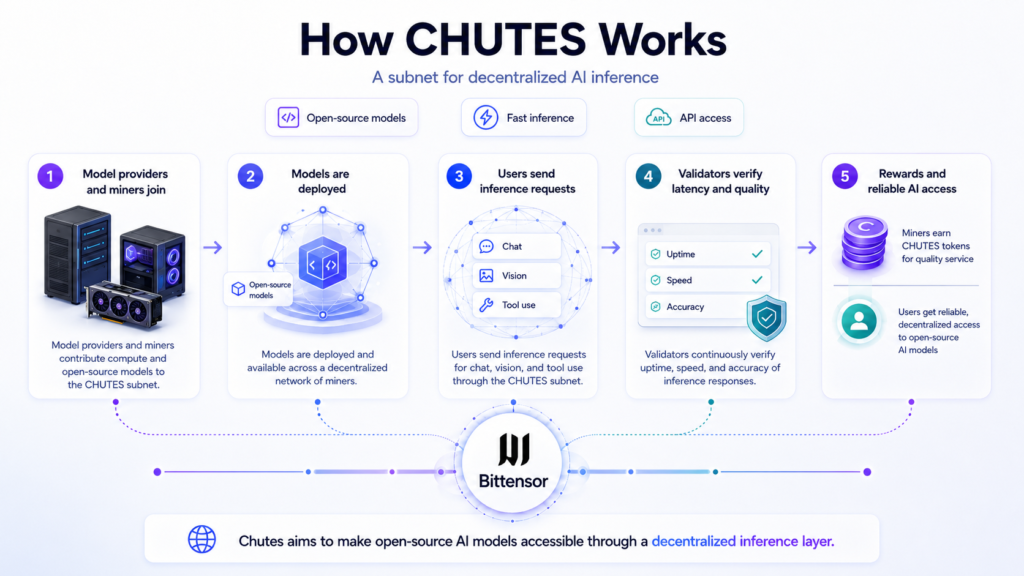
Miners on Chutes provide the hardware and infrastructure required to serve AI models. Open-source models and serverless AI workloads can be deployed across this capacity. Users then send inference requests to Chutes, and the platform routes those requests to miners able to perform the work.
Validators assess the service miners provide and influence how rewards are distributed. Relevant qualities include whether the requested model is available, how quickly it responds, whether the service remains online and how efficiently the miner uses its hardware.
Chutes’ public mining documentation describes the objective as providing as much useful compute as possible while improving cold-start performance and cost efficiency.
These details matter because inference is not simply a competition over who owns the largest GPU cluster. A miner with substantial hardware may still offer a poor service if models take too long to load, requests fail or capacity remains idle when customers need it. A smaller but better-managed deployment may provide more useful inference.
Chutes therefore coordinates several activities at once: access to hardware, model deployment, scaling, request routing and performance measurement. The user sees an API endpoint. The subnet organises the machinery behind it.
Why build this on Bittensor?
Inference is a relatively measurable digital commodity.
A requested model either responds or it does not. Latency, throughput and uptime can be observed. Validators can test whether miners are serving the correct models and producing valid outputs.
This makes inference a natural fit for Bittensor. Miners provide the service, validators measure performance and the network rewards the providers that perform best according to the subnet’s criteria.
A conventional inference company rents or owns capacity and manages it through one organisation. Chutes can invite independent miners to contribute hardware and compete to serve workloads.
In principle, this creates room for more experimentation. One miner may improve model-loading speeds. Another may specialise in particular GPUs or model architectures. Others may discover more efficient ways to batch requests, compress models or increase utilisation.
The incentive mechanism turns these improvements into an economic competition.
That does not automatically produce a useful service. Validators must measure the qualities customers actually care about. If the incentive system rewards raw capacity while users care about consistent latency, miners will optimise raw capacity. Bittensor creates the market, but Chutes still needs to define the correct product inside it.
The subnet’s strength is that the underlying commodity is concrete. The longer-term test is whether miner competition translates into inference that developers find reliable and economical.
Open models still need open infrastructure
The open-source AI movement weakens the idea that a few laboratories must control every important model. Yet model access and infrastructure access are separate forms of power.
A developer may be free to download a model while remaining dependent on Amazon, Microsoft or another large provider to run it. If those companies control the price of compute, the regions in which it is available and the workloads they allow, the model may be open while the practical serving layer remains centralised.
Chutes tries to extend openness into that serving layer.
This matters because the influence of an AI model depends on distribution. Closed-model providers became powerful not only by producing capable systems, but by making those systems easy to access through reliable APIs.
An open model that requires several days of infrastructure work before answering its first request is unlikely to compete with a proprietary service that can be added to an application in an afternoon.
Chutes gives open-source builders a possible route to similar convenience without requiring the complete backend to be controlled by one company.
Private inference through trusted hardware
Cost is not the only reason companies may prefer open models. Privacy and control also matter.
A company using a centralised AI API must send its requests to the provider operating the model. For ordinary public information, this may be acceptable. For legal documents, medical data, internal strategy or customer records, it becomes more sensitive.
Chutes has been developing confidential inference using trusted execution environments, or TEEs. These protected hardware environments are designed to prevent the operator of the physical machine from inspecting the data and software being processed inside them.
Remote attestation can provide evidence that the expected workload is running within the protected environment before the customer sends sensitive information.
This creates an interesting combination. An open-source model can be hosted by an independent Chutes miner, while the TEE limits that miner’s ability to inspect the user’s prompts and outputs. The customer gains access to cheaper and more controllable inference without simply transferring complete trust to an unknown server operator.
Other Bittensor compute and inference subnets may support similar architectures. If these systems mature, companies could route suitable workloads to open models running inside confidential environments rather than relying entirely on centralised APIs.
The protection is not absolute. TEEs depend on hardware manufacturers, correct implementation and the security of the surrounding software. They reduce certain trust requirements rather than eliminating trust altogether.
Even with that qualification, the combination of open models, lower inference costs and confidential computing could become highly attractive to professional users.
From inference subnet to application infrastructure
Chutes becomes especially interesting when considered as part of a broader AI stack.
An application may use several models rather than building itself around one permanent provider. Different models can be selected according to task complexity, cost, speed and privacy requirements. As new open models appear, they can replace older systems without requiring the entire application to be rebuilt.
A document assistant might use a small open model for classification, a larger open model inside a TEE for sensitive summaries and a leading closed model for the most difficult reasoning. The user experiences one service, while the inference layer makes several economic and technical decisions underneath it.
This makes models more interchangeable.
That could weaken one of the strongest forms of lock-in in the current AI market. Today, an application often becomes deeply attached to a particular provider’s API, pricing and behaviour. A model-independent inference layer could give developers more freedom to change the systems underneath their product.
Chutes is not the complete solution. Routing, quality control and compatibility remain difficult. But it provides an important part of the architecture: a place where open models can be deployed and accessed without every developer managing the hardware personally.
What Chutes still needs to prove
Chutes has a clear thesis, but production inference is a demanding business.
Developers expect low latency, high uptime and predictable behaviour. A decentralised backend may be philosophically interesting, but it has to become largely invisible to the person using it. Failed requests and unstable performance will not become more charming because they originated from an open network.
Pricing must also remain genuinely competitive. Miners face hardware, bandwidth, energy and maintenance costs. Users will compare the complete service with highly optimised centralised providers, including their discounts, support and reliability guarantees.
External demand is therefore more important than the amount of compute registered on the subnet. Emissions can attract miners and help bootstrap supply, but they do not prove that customers value the service enough to pay for it.
Chutes must also manage a difficult balance between model choice and efficiency. Supporting many models gives users flexibility, but it can spread hardware capacity thinly and increase cold starts. Concentrating on a smaller catalogue improves utilisation but limits the openness of the platform.
The strongest proof will come from sustained professional workloads: companies routing real inference through Chutes because the combination of capability, privacy and price is better than the alternatives.
Why this subnet is interesting
Chutes is one of the clearest examples of Bittensor providing infrastructure for open-source AI.
The resource is identifiable: inference compute. Miners supply it. Validators can measure the service. Developers can purchase something they already understand—access to AI models through an API.
Its wider significance comes from the convergence of three developments.
Open models are becoming capable enough to perform a growing share of useful work. Their inference can be considerably cheaper than premium closed-model APIs. Trusted execution environments may allow sensitive workloads to run on decentralised hardware without exposing the underlying data to the machine operator.
Together, these developments create the possibility of a more competitive AI economy.
I do not think companies will necessarily abandon closed models. The strongest proprietary systems will remain valuable for tasks where capability matters more than cost. But professional users may become far more selective about when they use them.
Routine work could be routed to inexpensive open models. Sensitive work could run on open models inside confidential hardware. The hardest requests could still go to the leading centralised laboratories.
Chutes is building infrastructure for that blended future.
Its success will depend on whether it can provide reliable service at meaningful scale. But the underlying economic logic is strong: as AI usage grows, businesses will care increasingly about what each token costs and whether every request truly needs the most expensive model available.
Open models are becoming useful enough to compete. Chutes is trying to make them cheap, private and accessible enough to matter.
More info: https://chutes.ai/