
Decentralized Private Compute for AI
A private compute grid for AI
There are Bittensor subnets that are difficult to explain without first introducing several layers of machine-learning theory. Targon is not one of them. Its ambition is technically complex, but the basic idea is refreshingly tangible: powerful computers should not have to sit inside a handful of enormous data centres before they can become useful to the AI economy.
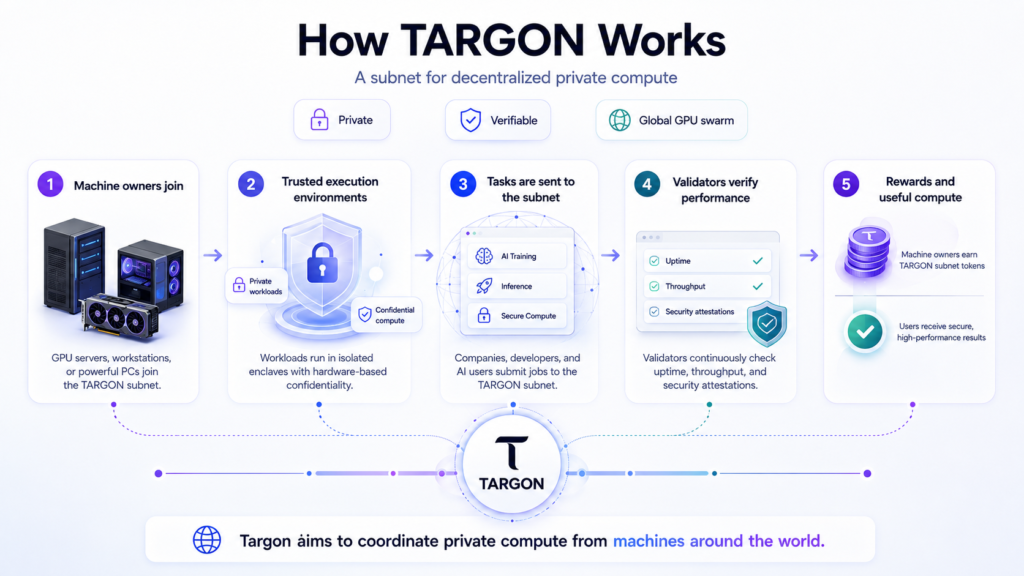
A company may need GPUs to run an AI model, train on private data or deploy an agent. Somewhere else, a machine owner has expensive hardware that is not being used all day. Targon wants to connect the two. The difficult part is that the company should not have to trust the machine owner with its data, code or model weights. Targon therefore combines a decentralized compute market with confidential computing: hardware-based protections intended to keep a workload private even while it runs on a computer controlled by someone else.
That combination is what makes Targon more interesting than a conventional marketplace for renting GPUs. It is not merely trying to locate unused compute. It is trying to make independently owned compute trustworthy enough for serious AI workloads.
I find this one of the easier Bittensor subnets to become genuinely enthusiastic about. Compute is already one of the central constraints in AI, privacy will become more important as AI moves deeper into companies and personal lives, and the resource being coordinated is real hardware rather than an abstract benchmark. Targon is attempting to connect all three.
The simple idea
AI models require machines. Training requires them, but so do inference, fine-tuning, video generation, scientific simulations, data processing and the growing number of agents that may eventually run continuously on behalf of people and businesses.
Today, most of this work takes place inside centralized clouds and large data centres. That arrangement is efficient, and the major cloud providers offer excellent infrastructure, but it also concentrates access, pricing and trust. A startup running a proprietary model on somebody else’s cloud has to accept that the provider controls the underlying machines. A hospital analysing medical information faces the same basic problem with much more sensitive consequences. Encryption can protect information while it is stored or travelling across a network, but ordinary computation eventually requires that the data becomes readable somewhere inside the machine.
Targon’s answer is the Targon Virtual Machine, or TVM. It uses confidential-computing technologies including Intel TDX and NVIDIA Confidential Computing to create encrypted virtual machines whose internal data and execution are intended to remain inaccessible to the hardware provider. Before the machine receives a workload, the system can remotely verify—or attest—that the expected hardware and software environment is actually running.
In ordinary language, Targon is trying to let you use a stranger’s computer without having to treat that stranger as trustworthy.
That is a difficult promise to fulfil, but also an unusually useful one.
What problem does Targon solve?
The first problem is access to compute. High-performance GPUs are expensive, and the most capable machines are concentrated among cloud providers, specialist GPU companies and large AI laboratories. Smaller developers and researchers can rent them, but availability and price remain dependent on relatively few companies.
The second problem is utilisation. GPUs are productive assets, but privately owned machines are rarely working at full capacity every hour of the day. A workstation may be heavily used during a model-training job and then sit idle overnight. At a larger scale, that unused capacity represents an enormous pool of computation that cannot easily be accessed by outsiders.
The third problem is trust. Decentralising the hardware does not automatically make the system suitable for confidential work. In fact, it initially makes the trust problem worse. A workload that leaves a familiar cloud and moves onto an anonymous miner’s server may be cheaper or more open, but the miner physically controls the machine.
Targon’s architecture is built around this uncomfortable fact. Its whitepaper does not assume that hardware providers are friendly, known or reputable. It assumes that they may control the host operating system, hypervisor, firmware and physical machine, and then tries to isolate the customer’s virtual machine from them through encrypted storage, protected memory and repeated attestation.
This is the central challenge of decentralized compute: finding machines is relatively easy; making those machines usable for private workloads is much harder.
What does Targon actually do?
From the customer’s perspective, Targon operates as a compute cloud. Developers can rent CPUs and GPUs, deploy virtual machines, attach persistent storage and run workloads such as model inference or training. Its current inventory includes several GPU families, ranging from RTX 4090-class machines to H100, H200, B200 and B300 infrastructure, alongside confidential virtual-machine options.
Behind that interface, independent providers supply the hardware. Targon’s current mining system uses TargonOS, a signed operating system that prepares a machine for participation in the network. Once installed, it handles attestation, encrypted storage and the Targon services required to make the node available. The machine repeatedly proves that it is running the expected protected environment; if that verification fails, it should no longer remain eligible to receive workloads.
The validators are therefore not merely testing whether a GPU can produce a benchmark score. They are helping verify that the hardware exists, remains online and is operating in the required confidential state. Eligible providers receive subnet emissions according to the hardware categories and auction targets defined by the network.
The customer sees rentable compute. The provider sees an income-producing machine. Bittensor coordinates the market between them.
The Targon Tower
The recently announced Targon Tower Pro makes this vision much easier to picture.
Until now, decentralized compute has often remained an abstract idea: somewhere, anonymous providers operate servers that eventually appear inside an online marketplace. The Tower turns the hardware provider into a visible product. It is a computer that an individual or organisation can own, use locally and place into Targon’s Earning Mode when its capacity is no longer needed.
The simplest comparison is a small private power grid. You use the capacity locally when you need it; when you have surplus, you make it available to the network. The Tower does this with computation rather than electricity.
An owner could run open models locally, keep data on premises, experiment with training or use the machine as private AI infrastructure for a business. When the GPUs would otherwise sit idle, the owner can switch the machine into Earning Mode and allow its capacity to join Targon’s confidential compute network. Targon describes this as a way to “flip a switch” between local use and passive monetisation.
At that point the Tower is no longer only a private workstation. It becomes a Targon provider—and, where the hardware and participation route are eligible, effectively a miner supplying GPU capacity to the subnet.
This is the part of the project that I find particularly exciting. Instead of assuming that the AI future must be built exclusively through ever-larger facilities owned by a small collection of technology companies, Targon is exploring a world in which compute ownership becomes more distributed. A person, research group or small company could own serious AI hardware, use it privately and allow the hardware to become productive for the wider network during its downtime.
Why build this on Bittensor?
A conventional compute company usually raises capital, purchases machines, installs them in data centres and attempts to keep those machines rented. Growth requires the company to keep acquiring hardware or sign contracts with a limited set of infrastructure partners.
Bittensor allows Targon to take a different route. The subnet can define the kinds of hardware it wants, establish rules for verifying that hardware and use incentives to attract independent providers. Rather than Targon owning every GPU, the market can reward people who bring suitable machines into the network.
Compute is particularly compatible with this model because much of the contribution can be measured. A machine either possesses the claimed hardware or it does not. It is online or offline. Its confidential environment passes attestation or fails. Its performance, availability and workload completion can be observed.
This does not make the incentive design simple. Targon still has to prevent participants from gaming measurements, keep sufficient capacity available and connect supply to real paying demand. But the commodity itself is clearer than in many AI subnets. Targon is not asking validators to decide which miner produced the most beautiful paragraph. It is asking them to verify the provision of usable, protected machine resources.
The subnet structure can also help bootstrap the network before ordinary rental demand is large enough to support every provider. Miners currently earn through hardware-specific subnet auctions, with target capacity and capped payment levels for different card classes. Over time, the most convincing economic model would be one in which external customers increasingly pay for the compute and Bittensor incentives help the network allocate and expand it.
Why is Targon helpful?
For developers, Targon offers another route to high-performance compute without requiring them to purchase the hardware themselves. For researchers and smaller AI companies, it could widen access to machines that would otherwise remain concentrated in large clouds. For organisations handling sensitive information, its confidential virtual machines may provide stronger assurances when workloads have to run on third-party infrastructure.
For hardware owners, the attraction is almost the reverse. A GPU cluster is expensive, and idle hours do nothing to recover that cost. Targon gives the owner a possible route to use the hardware privately while retaining the option to sell spare capacity.
The Tower is the cleanest expression of this dual use. It asks people to stop thinking of local AI and cloud AI as entirely separate worlds. The same machine can serve its owner during one part of the day and become part of a distributed cloud during another.
For Bittensor itself, Targon offers a valuable test. It asks whether the network can coordinate something physical, capital-intensive and commercially familiar. Compute has real customers, real operating costs and an obvious alternative in the form of existing cloud providers. Success cannot be sustained indefinitely through a clever benchmark alone. The network eventually has to provide machines that people actually want to rent.
That makes Targon’s progress unusually informative for the wider Bittensor thesis.
Why is Targon interesting?
Many decentralized-compute projects begin with the claim that there is unused hardware in the world. That is probably true, but it is only the beginning of the problem. The compute needs to be reliable, consistently available, easy to purchase and safe enough for the work being sent to it.
Targon appears to understand this. Its focus on TargonOS, confidential virtual machines, hardware attestation and a normal cloud-style customer interface suggests that it is trying to build infrastructure rather than simply count GPUs.
The Targon Tower adds a second dimension. It gives users a reason to own capable hardware for themselves while creating a mechanism through which that ownership can also contribute to a shared market. Local open-source AI and decentralized cloud compute are usually presented as competing visions. The Tower tries to make them complementary.
You own the machine. You decide when to use it. You can run models locally without sending every prompt to a distant provider. When you are finished, the same hardware can serve other workloads and potentially earn revenue.
Whether this develops into a large distributed compute grid will depend on economics, demand, electricity costs, reliability and the willingness of customers to trust the confidential-computing architecture. The first Tower Pro configurations are also far too expensive and specialised to suggest that a mass market has already arrived.
But the direction is compelling. It offers a more concrete answer to the decentralisation of AI than simply making another chatbot available through an API.
Instead of moving every model and every dataset into a handful of larger data centres, Targon is asking whether parts of the AI cloud can be brought back into privately owned machines—and whether those machines can still cooperate as one network.
Beginner takeaway
Targon is building a decentralized market for high-performance, confidential compute.
Independent providers connect suitable GPU and CPU hardware. Targon’s virtual-machine architecture is intended to keep customer workloads protected from the owners of those machines. Bittensor incentives reward providers that make verified compute available, while developers can rent the resulting capacity through a familiar cloud interface.
The Targon Tower turns that architecture into a physical product. Its owner can use powerful GPUs locally—for example to run open-source AI models—and place the cluster into Earning Mode when the capacity is idle. The computer then becomes part of Targon’s wider network, subject to the eligibility rules of the chosen configuration.
It is still early, and the current Towers are closer to privately owned server clusters than consumer PCs. Yet the underlying idea is easy to understand and, at least to me, unusually exciting.
The prevailing AI infrastructure model says that the future belongs to ever-larger data centres.
Targon is exploring another possibility: a world in which people and smaller organisations own part of the compute themselves, keep it private when they need it, and connect it to an open market when they do not.
More info: https://targon.com/