
Bittensor is not one AI model. People keep looking for the chatbot, the flagship product, the one thing to point at — and that’s just the wrong way to think about it.
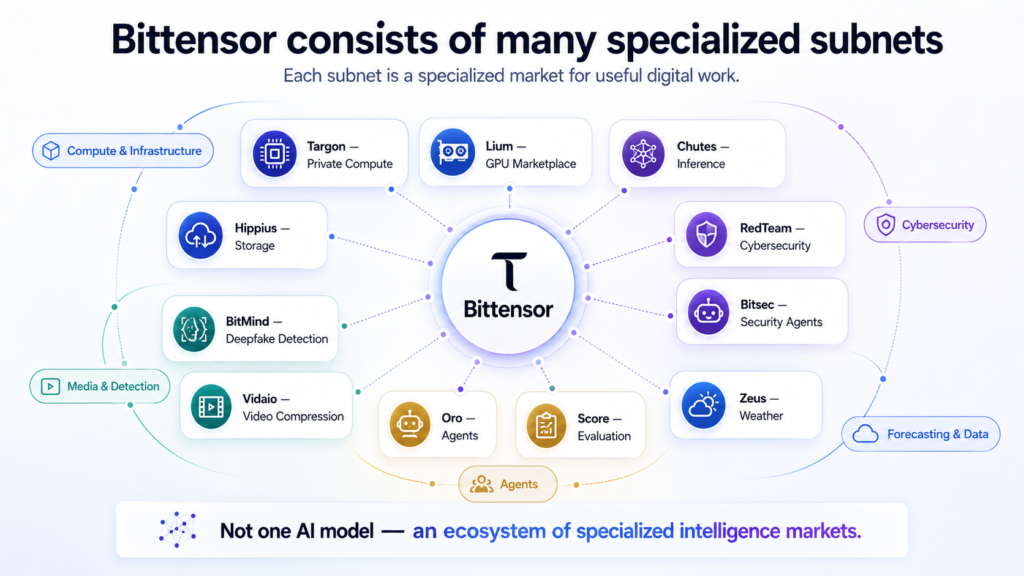
What it actually is: an ecosystem of specialized markets — subnets — where miners compete to produce useful digital work. Some subnets provide GPU compute. Some search for software vulnerabilities. Some detect deepfakes. Some compress video. Some store data. Some forecast weather. Some build agents. Some train or evaluate models in weirdly specific domains you’d never guess needed their own market.
That’s what makes Bittensor so interesting to me. It’s almost limitless in terms of applications. It’s not trying to build a better chatbot — it’s trying to build an open economy for digital commodities and AI.
What is a subnet?
A subnet is a specialized market inside Bittensor.
Each one defines a task. Miners compete to do that task well. Validators judge the quality of what comes in. The best contributors get paid.
Think about it this way: Bitcoin pays miners to secure money. Bittensor subnets pay miners to produce useful digital work instead.
That work can look like almost anything. One subnet rewards miners for GPU compute. Another rewards them for finding bugs in code. Another rewards them for spotting synthetic media. Others reward better forecasts, better compression, better storage, better AI agents.
This is why subnets are the actual heart of Bittensor. They’re what turns it from an abstract “AI crypto network” into a growing pile of real experiments.
Why subnets matter
Most people still think about AI the centralized way — one giant company, one giant data center, one giant model, one API. That’s the whole mental model, and it’s basically all they know.
Bittensor just doesn’t work like that. Instead of betting that one model will do everything, it lets a ton of specialized markets emerge, each one focused on a specific problem, each one rewarding whoever solves that problem best.
Why does this matter? Because I don’t think the future of AI is only one giant general model. So much valuable work needs specialized intelligence instead — cybersecurity, video compression, confidential compute, deepfake detection, storage, weather forecasting, financial analysis, scientific prediction, agents, and plenty more nobody’s even built yet.
A model that’s excellent at compressing video doesn’t need to write poetry. A cybersecurity agent doesn’t need to know every fact in human history. A weather subnet doesn’t need to double as a general chatbot. It just needs to be really, really good at its own narrow thing.
That’s the power of subnets, plain and simple — they let Bittensor become a network of specialized intelligence markets instead of one model pretending to do everything.
A tour through the subnet categories
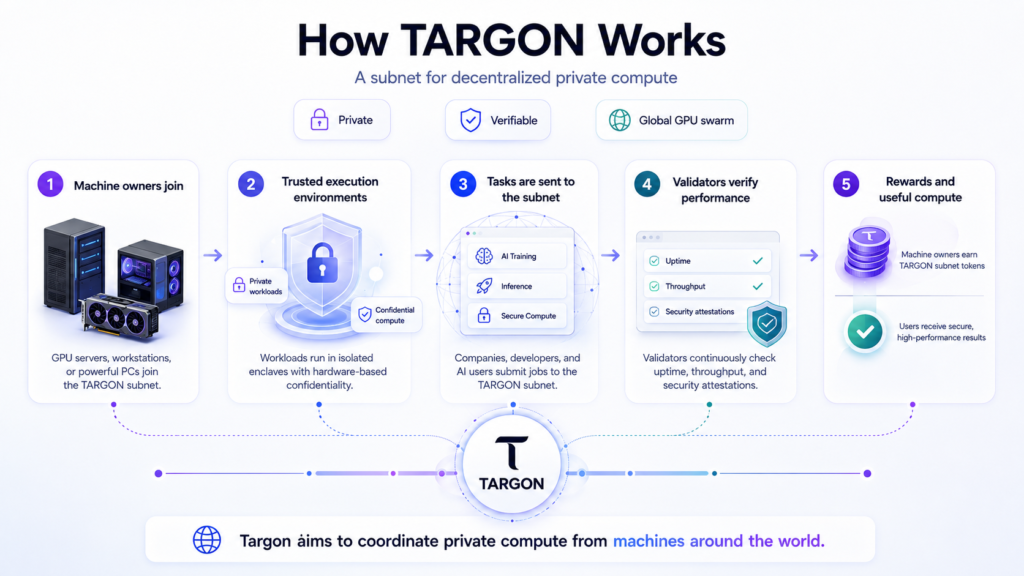
Compute and infrastructure. AI needs compute — lots of it. As models keep getting bigger and usage keeps growing, access to GPUs, storage and infrastructure might end up being one of the biggest bottlenecks in the whole AI economy. Bittensor’s compute subnets are trying to coordinate those resources in a decentralized way. Targon does decentralized private compute using trusted execution environments. Lium is a global GPU marketplace where miners provide compute and anyone can rent it. Chutes is a decentralized inference platform for accessing open-source models. Hippius handles decentralized storage infrastructure built for the Bittensor ecosystem.
Cybersecurity and adversarial intelligence. Cybersecurity is naturally competitive — attackers adapt, defenders adapt, and models need constant testing, challenging and improving. Which is exactly why I think it’s one of the most natural use cases Bittensor has. Bitsec is a cybersecurity subnet where AI agents compete to find vulnerabilities in code. RedTeam runs adversarial security challenges and real-world cyber problem solving. Yanez focuses on identity, humanhood and compliance — fraud, synthetic identity, verification.
Media, video and detection. Not all AI is chat! Some of the most valuable AI systems out there work with images, video, audio and media authenticity, and Bittensor can build specialized competitions around compression, upscaling, generation and detection. Vidaio focuses on video compression, upscaling and media optimization. BitMind works on synthetic media detection through adversarial competition. 404gen is a creative media subnet exploring generative content and visual AI. And Itsai is genuinely fun to try — it’s built around detecting AI-generated text, and you can literally upload text (like this article!) and see which parts get flagged as AI-written and which don’t.
Agents and automation. AI agents are systems that do tasks, use tools, make decisions and improve through feedback — and Bittensor could become a really powerful testing ground for agentic AI, because subnets can reward agents purely based on measurable performance. Oro explores real-world task execution and agent benchmarking. Ridges focuses on model performance, reasoning and specialized AI capabilities.
Forecasting, data and real-world intelligence. Some intelligence has nothing to do with chatbots at all — it’s about prediction, optimization and decision support. Weather, markets, risk, logistics, agriculture, energy, all of it depends on better forecasting. Zeus is a weather intelligence subnet focused on hyperlocal forecasting. Almanac explores forecasting and prediction markets built on real-world signals.
Why most subnets will fail
This part matters, so pay attention: not every subnet is going to succeed. In fact, most of them probably won’t.
And honestly? That’s completely normal. Bittensor is still early. Plenty of subnet ideas will turn out to be poorly designed. Some incentive mechanisms will get gamed. Some teams just won’t execute well. Some products will never find real users. Some subnet tokens will get overvalued and then collapse back down.
Compare it to the early internet — most websites and businesses from that era collapsed by the early 2000s. I wouldn’t be surprised if Bittensor goes through the exact same shakeout.
The real question was never “will every subnet succeed.” It’s whether the network keeps discovering better subnets over time. Weak experiments should disappear. Strong ones should pull in miners, validators, users and capital. That’s just how an open market is supposed to evolve.
What makes a good subnet?
A good subnet shouldn’t just have a good narrative — it needs to actually produce something useful.
So when I’m sizing one up, I’m really asking: does it solve a real problem? Can miners genuinely compete to improve the output, or is it rigged toward whoever got there first? Can validators actually measure quality, or are they just guessing? Is the incentive mechanism hard to game? Are there real users, or at least potential customers? Is there revenue, or a believable path to revenue? Does it add value to the broader Bittensor ecosystem, or is it just riding the ecosystem’s coattails?
And then there’s the question I think matters most of all: does the subnet’s token actually capture value, or is it purely a speculative asset floating on vibes?
That last one is easy to get wrong. A subnet can be genuinely useful without its token ever becoming valuable. And a token can pump hard without the subnet underneath it being fundamentally strong at all. Subnet investing is risky precisely because the market hasn’t figured out how to value these things yet.
Worth remembering: subnets aren’t equity. They’re not a guaranteed claim on company revenue. They’re incentive assets living inside experimental digital markets. That distinction matters more than people give it credit for.
Why companies may want subnets
For some companies, running a subnet could turn into a genuine competitive advantage.
Picture a traditional cybersecurity company — it hires engineers, builds products internally, runs its own tests, maybe spins up a bug bounty program, and improves slowly, one release at a time.
Now picture a Bittensor cybersecurity subnet instead. Miners all over the world are competing around the clock to find vulnerabilities. Validators score what comes in. The best contributors get paid. The product just keeps improving, continuously, without anyone having to hire a single extra person.
That’s not fundraising. That’s not marketing. That’s a genuinely new kind of R&D engine — I went deeper on this exact idea in my earlier piece, “The Real Superpower of Bittensor,” if you want the extended version.
Which is why I think some subnets could end up valuable even if their tokens never turn into huge financial assets. For teams building in cybersecurity, identity, deepfake detection, compression, compute or forecasting, a subnet basically hands you a swarm of contributors constantly making your product better. That’s one of the most powerful ideas Bittensor has going for it.
The big idea
Bittensor gets misunderstood constantly because people keep looking for one product. But it was never meant to be one product — it’s a system for creating a bunch of specialized markets at once.
That’s why subnets matter so much. They’re where the actual useful work happens. They’re where miners compete, where validators measure quality, where Bittensor’s whole abstract thesis turns into something concrete you can point at.
If Bitcoin created an open monetary network, I’d say Bittensor is trying to create open markets for machine intelligence itself. Whether that works is genuinely an open question — Bittensor is still young, complex and risky, it’s nowhere near as decentralized as Bitcoin yet, its incentive mechanisms can absolutely be gamed, plenty of subnets will fail, and the tokens are highly speculative.
But I still find the experiment fascinating. Because if intelligence ends up being one of the most important resources in the world — and I think it will be — then open markets for intelligence could end up being extremely valuable too.
Start exploring
Begin with some of the most interesting subnets in the Bittensor ecosystem:
Targon — private decentralized compute
Chutes — decentralized AI inference
Hippius — decentralized storage
RedTeam — adversarial security challenges
Yanez — identity, humanhood and compliance
Score — data and evaluation
Babelbit: real-time translation that starts before the speaker has finished.
Bittensor is complex.
Subnets make it understandable.
I have tried to describe these subnets in a not too technical manner allowing newcomers to understand more or less why (some of) these subnets are fascinating and why Bittensor is such a unique project.