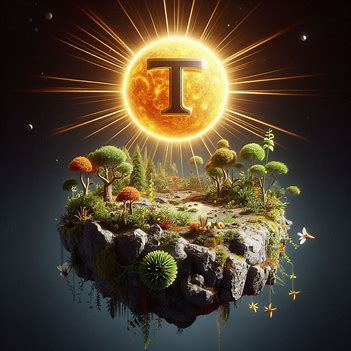
The Bittensor Ecosystem: How the Network of Subnets Works
The Bittensor ecosystem is a network of specialized AI markets called subnets. Each subnet focuses on a specific task — such as compute, storage, or model evaluation — and competes for TAO emissions based on the value it produces.
Bittensor is difficult to understand if you approach it purely through code.
You can read the whitepapers, inspect the repositories, memorize the terminology and still miss the shape of the thing. That’s because Bittensor isn’t just a protocol. It’s an economic environment.
On this page, I’ll use two mental models: a growing forest and a planet of emerging cities. They describe the same system from different angles. The forest helps you understand how value accumulates and how resilience forms over time. The city helps you see how labor, capital, and incentives move through the system.
Planet Bittensor: From Bare Planet to Living Forest
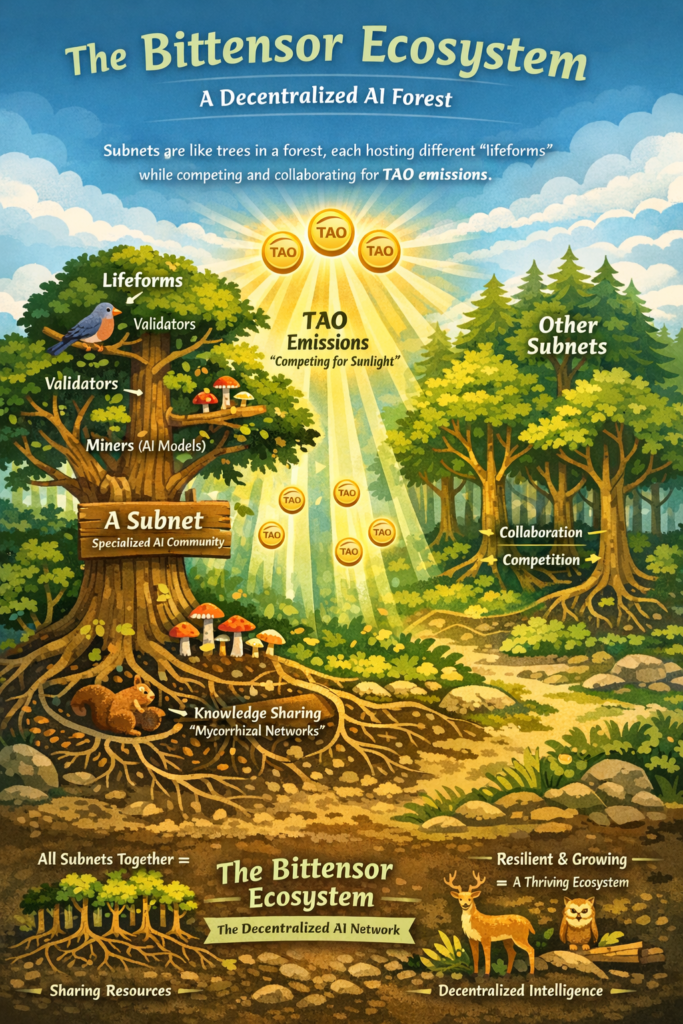
Imagine a rocky planet. Empty, quiet, structurally intact but unused. That planet is Bittensor at genesis. No subnets. No competition. Just potential.
Then life begins.
Small moss appears: early subnet experiments. Limited activity. Fragile growth.
Ferns and grasses follow: smaller subnets testing narrow functions. Some survive. Some don’t.
Eventually, trees begin to grow: stronger subnets establish themselves, attract miners, and begin shaping the economic canopy.
Over time, the landscape stops looking barren. It becomes a forest.
And here’s where the metaphor becomes useful.
A forest isn’t organized by committee. It grows through competition and adaptation (and also collaboration). Trees compete for sunlight. Roots compete for nutrients. Some species dominate temporarily. Others specialize quietly in the shade.
Bittensor behaves similarly.
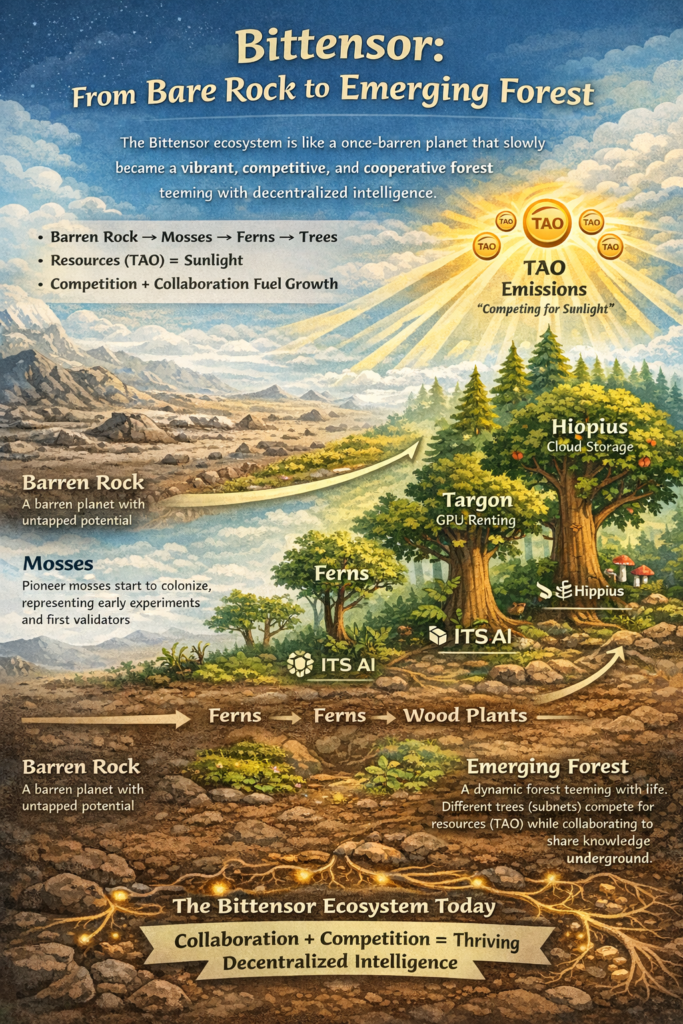
Subnets compete for emissions — the TAO energy that allows them to expand, attract miners, and improve performance. The more useful a subnet becomes, the more emissions it can capture. The more emissions it captures, the more economic gravity it builds.
That doesn’t guarantee survival. Forests self-correct. But it creates evolutionary pressure.
At the same time there is collaboration. In a forest, trees can share nutrients and water via fungal networks (the wood wide web). In Bittensor, subnets can use other subnets (for cheap inference, data storage etc.) instead of non-bittensor options. This collaboration actually increases the resilience of the entire bittensor ecosystem, just like in a forest.
Bittensor Subnets: Trees and Shrubs in the Forest
In this forest analogy, each subnet is a tree or shrub. Some are tall and highly visible (key species). Others are small but ecologically important.
Life in the forest — miners, validators, stakers — lives on and around these trees. They compete, collaborate, and adapt.
Some trees dominate the canopy.
Some quietly stabilize the soil.
Both matter.
Big Trees — The Powerhouses of the Forest
Certain subnets capture more sunlight (emissions) and shape the broader environment.
Chutes — The Tall Oak of Compute
Chutes provides serverless compute infrastructure. Think of it as a tall oak that supports large branches and heavy workloads. Other subnets depend on it to run models without managing their own infrastructure. It is a true key species of the Bittensor Ecosystem.
Targon — The Redwood of GPU Power
Targon focuses on GPU rental and infrastructure. Like a redwood, it grows through depth as much as height. GPU supply is foundational to AI production. Without compute, nothing else scales. It uses Trusted Excecution Environment (TEE) to encrypt prompts locally. This means that your data cannot be seen by the miners (when using their GPU’s for example to run models) or by the subnet itself.
Hippius — The Beech tree of Storage
Hippius provides decentralized storage. It’s less flashy than compute, but equally necessary. Data, checkpoints, and model artifacts need somewhere to live.
Storage subnets are another key species in a forest. They are indispensable for the overall functioning of the ecosystem.
Without them, the forest would be radically different.
Smaller Trees & Shrubs — Specialized Helpers
Not every subnet needs to dominate emissions to matter.
Some specialize narrowly and strengthen the ecosystem in precise ways.
ITS AI — The Versatile Shrub
ITS AI focuses on AI text detection. It doesn’t tower over the canopy. But it performs a specific function that benefits the world and the bittensor ecosystem. Shrubs don’t block the sun. They improve the soil.
Bitmind — The Watchful Bush
Bitmind works on AI video and image detection. In a world where synthetic content proliferates, that function becomes economically relevant.
Yanez MIID — The Niche Fern
MIID focuses on identity simulation and testing. It may operate in a smaller niche, but niches are often where resilience forms. Forests collapse when they lack diversity. Economic systems behave similarly.
How Subnets Interact
Forests are not just collections of trees. They are networks.
Competition for sunlight keeps growth disciplined. In Bittensor, subnets compete for emissions of the TAO token. The more useful they are, the more emissions they receive. Emissions increase their ability to attract miners and improve outputs. That feedback loop creates upward pressure — but only if usefulness is real.
Collaboration also strengthens the environment. Subnets share infrastructure and services. A subnet focused on identity testing might use storage from Hippius. A data-heavy subnet may rely on compute from Chutes. Specialized subnets interlock.
That interdependence reduces fragility. Even smaller subnets contribute diversity. And diversity matters. A monoculture forest may grow quickly, but it is vulnerable to collapse.
The same applies here.
Why This Helps You Understand Bittensor
Seeing Bittensor as a forest clarifies something important:
- It is not one AI model.
- It is not one company.
- It is not one product.
It is an ecosystem of competing and cooperating intelligence systems, all rooted in a shared economic soil. The TAO token functions as the sunlight — the energy source driving growth. But sunlight alone doesn’t create a forest. The species must be viable.
If subnets produce real value, the forest becomes resilient. If they don’t, emissions redistribute and weaker growth recedes.
A Second Look: Bittensor as a Planet of Cities
If the forest shows biological growth, the city shows economic coordination.
Now imagine Planet Bittensor not as trees, but as interconnected cities.
Each city specializes.
Chutes City focuses on compute.
Targon City rents GPU infrastructure.
Hippius City stores data.
Smaller towns specialize in detection, identity, verification.
Each city:
Employs workers (miners) who produce output.
Has inspectors (validators) who evaluate quality.
Pays in the shared currency (TAO).
Reinvests when it captures more economic activity.
TAO functions like a shared planetary currency. It routes economic activity across cities. Holding TAO does not mean you own a building in one district. It means you are exposed to the broader economic system.
If cities generate real output, the currency remains central.
If activity declines, the currency loses structural relevance.
Example Subnets
Below are some more examples of interesting and diverse subnets — what they are and why they matter
You can use dedicated websites like https://subnetalpha.ai for more detailed information and updates on all the subnets and click on the SubNet (SN) number behind the subnet name in the examples below, to find more detailed information.
🔥 1) Chutes (SN64) — Decentralized AI Compute
What it does:
Chutes enables serverless AI compute — meaning developers can deploy and run AI models across thousands of distributed GPUs without owning the hardware.
Why it’s fascinating:
It functions like a decentralized AWS for AI — connecting users to scalable compute that competitively rewards miners for providing inference power. This helps decentralize one of the most expensive pieces of AI infrastructure.
🗄️ 2) Hippius (SN75) — Decentralized Storage Layer
What it does:
Hippius provides decentralized, blockchain‑backed storage for AI data and models — similar to Filecoin/Arweave but natively part of the Bittensor ecosystem.
Why it’s fascinating:
Storage is essential for distributed AI. Hippius makes it secure, censorship‑resistant, and economically incentivized — so models and data aren’t tied to centralized cloud providers.
🧬 3) Bitmind (SN34) — Fake image and video detection
What it does:
Bitmind allows you to see if photos or videos are real or AI generated.
Why it’s fascinating:
This is, and will be, an extremely important feature of Bittensor. With AI getting better every day, it gets harder and harder to separate real from fake. Try their app here.
🧠 4) It’s AI (SN32) — AI Content Verification
What it does:
Designed to detect AI‑generated content, providing tools to verify whether text was created by AI or humans. This is an important service in the age of misinformation and generative AI.
Why it’s fascinating:
It creates trust infrastructure for digital content — something increasingly vital across journalism, social platforms, and knowledge integrity.
🟣 5) TAO Private Network (SN65) — Decentralized Privacy/IP Access
What it does:
This subnet supports privacy‑focused networks, like decentralized VPN and censorship‑resistant routing over the Bittensor system.
Why it’s fascinating:
It shows how Bittensor’s model expands beyond AI into internet infrastructure, enabling private and global access without centralized bottlenecks.
🛡️ 6) Bitsec (SN60) — Security & Vulnerability Detection
What it does:
Bitsec focuses on detecting vulnerabilities and security risks in code and systems using decentralized AI models. It works with validators and miners to continuously improve security insights.
Why it’s fascinating:
Security is crucial for any digital network. Bitsec creates a community‑driven defense layer, making Bittensor stronger and safer through shared intelligence.
🤖 7) Affine (SN120) — Reinforcement Learning Platform
What it does:
Affine is a subnet focused on reinforcement learning (RL) tasks, using decentralized feedback loops to improve AI models through competition and refinement.
Why it’s fascinating:
RL has applications from autonomous agents to game‑playing AI. Affine pushes this beyond centralized labs into a distributed, participant‑driven ecosystem.
🧠 8) Bitcast (SN93) — Creator Economy Intelligence
What it does:
Bitcast is focused on rewarding creators, distributing TAO to contributors who generate valuable content, stories, and insights. Content makers on X and Youtube are briefed by Bitcast. They make content which is then checked by AI, and earn rewards (Bitcast alphatokens).
Why it’s fascinating:
This hybrid of AI + creator economics disrupts how content is valued and distributed, with meritocratic rewards instead of platform‑controlled distribution.