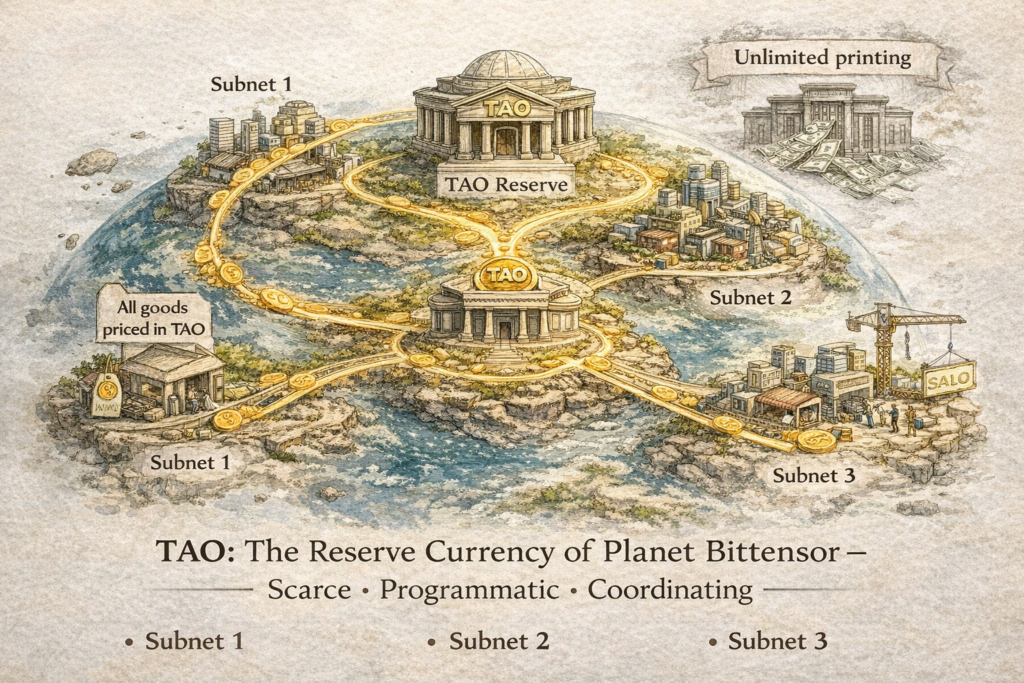
The Bittensor Ecosystem: A Planet of Emerging Cities
*Credits to Siam Kidd who first described Bittensor as an emerging city or planet of cities and inspired me. I built on top of his metaphor and hopefully refined his idea even more.
When most people first encounter Bittensor, it feels less like visiting a new city and more like being dropped into a control room full of blinking panels. Subnets. Validators. Emissions. Stake weight. You can learn the vocabulary and still have no idea what is actually happening. That confusion is not a sign of low intelligence. It is a sign that the system lacks a visual anchor. So instead of starting with code, let’s start with concrete. Imagine a new planet. Not a finished civilization, but a young world where the first serious cities are just beginning to rise.
On this planet, the roads are still being paved. The electrical grid is being extended. The plumbing sometimes works beautifully and sometimes reminds you that infrastructure is hard. There are construction cranes everywhere. Some neighborhoods look promising. Others are ambitious sketches. This planet is Bittensor. And the cities being built on it are called subnets.
A city, in the normal world, rarely exists without a specialty. One becomes a port. Another becomes a financial center. Another becomes known for manufacturing or biotech or software. Cities that try to do everything usually end up doing nothing particularly well. Specialization attracts talent. Talent attracts capital. Capital builds more infrastructure. That feedback loop is what turns a settlement into a real economy.
On Planet Bittensor, each subnet defines its own specialty. One city may focus on compute markets. Another may build GPU infrastructure. Another may develop fraud detection models. Another might focus on decentralized storage, identity systems, or forecasting engines. Each subnet chooses a digital industry and says: this is what we produce here. Technically, that means it defines a task, a scoring model, and an incentive mechanism. Practically, it means the city chooses its economic identity.
Now walk into one of these cities. You will find a working population. In Bittensor language, these are miners and validators. Miners are the builders, engineers, and factory workers of the city. They produce the actual digital goods — compute, predictions, stored data, model outputs — depending on what the subnet has chosen as its industry. If the city is about fraud detection, miners compete to build the best fraud models. If it is about compute, they compete to provide reliable processing power. Production is competitive by design.
Validators, meanwhile, function as upper-level management and quality inspectors combined. They do not produce the goods themselves. Instead, they evaluate what miners produce, set performance weights, and coordinate the reward structure. If miners are the industrial base, validators are the coordination layer. They ensure that rewards follow measurable performance rather than noise. It is not corporate management with corner offices. It is economic management through stake-weighted consensus.
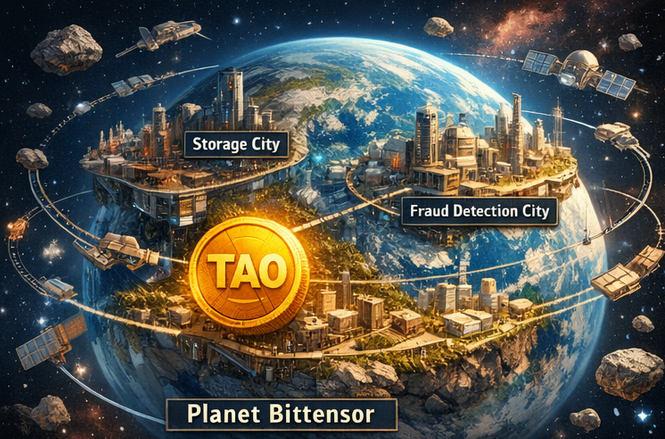
Zoom out again. Every planet needs a currency. On Planet Bittensor, that currency is TAO. You can think of TAO as the planet’s dollar — the reserve currency connecting all cities. But there is one important difference from traditional dollars. TAO follows a capped issuance schedule and cannot be printed at political convenience. Its supply expands according to predefined rules and is gradually reduced through halving events. There is no central bank meeting deciding to “stimulate” the ecosystem on a Tuesday afternoon.
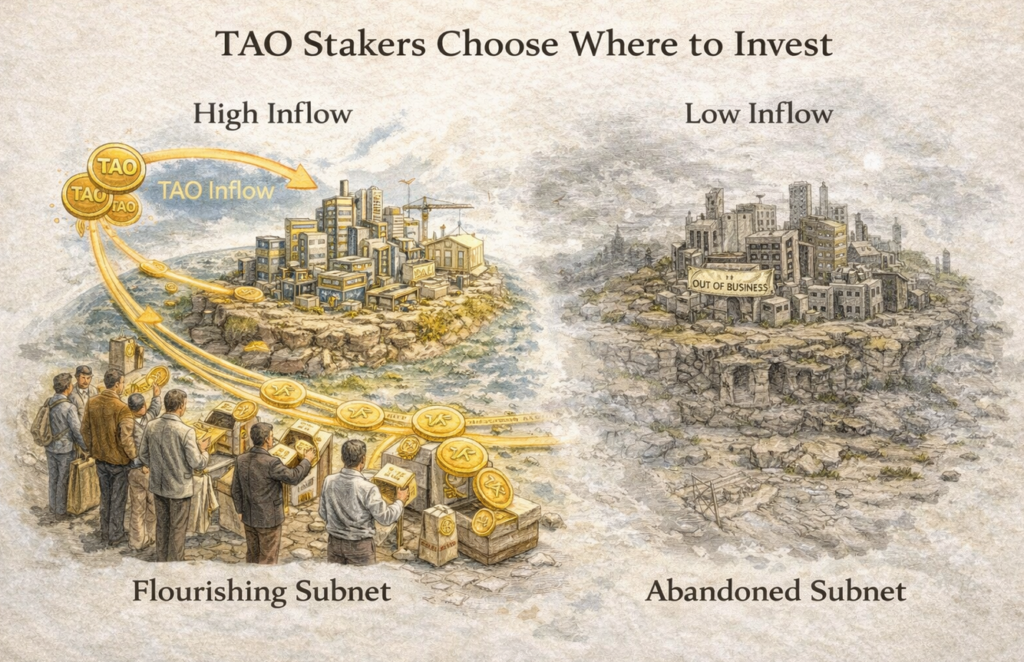
New TAO is minted steadily and injected into the planetary economy. But not every city receives equal energy. Under the flow-based emission model, cities receive emissions based largely on net TAO flows — staking minus unstaking. If more capital flows into a subnet than out, it registers positive net flow and maintains or increases its emission share. If capital consistently leaves, emissions eventually drop to zero. In other words, cities must attract and retain capital to keep the lights on. No visitors, no expansion budget.
This is where stakers enter the picture. If miners are workers and validators are managers, stakers are the capital allocators. When you stake TAO into a subnet, you are effectively investing in that city. You are saying: I believe this place will produce value. And under the current emission design, that belief has structural consequences. Sustained inflows increase a subnet’s share of planetary emissions. Sustained outflows reduce it. Capital allocation shapes energy distribution.
Cities do not grow because someone writes a persuasive blog post about them. They grow because talent produces value and capital stays. On Planet Bittensor, miners can migrate. A miner who previously worked in a compute subnet might decide that a fraud detection subnet offers better incentives and move there. Validators can shift focus. Participation is mobile. If a city stagnates, its working population may drift toward more dynamic districts. There are no immigration officers stopping them at the border.
The entire planet is still under construction. The blockchain layer acts as the legal registry and power grid. Liquidity pools are the financial plumbing. Emissions are the energy supply. Much of this infrastructure is still being refined. That matters. A city with brilliant workers but unstable roads will struggle. A subnet with clever design but weak infrastructure will find growth harder than expected. Infrastructure maturity and economic specialization must evolve together.
Not every city will succeed. Some will define tasks that sound impressive but fail to attract real demand. Others will struggle with validator coordination or capital retention. Some will become ghost towns with interesting documentation. That is not drama. That is competitive selection. The protocol does not guarantee prosperity. It guarantees open competition under shared monetary rules.
The long-term strength of TAO depends on whether these cities produce durable digital goods that external users care about. Scarcity alone does not create value. It amplifies it. If compute subnets power real applications, if fraud detection subnets reduce real losses, if storage subnets secure real data, then capital flows will reflect substance. If activity remains mostly internal, the monetary layer risks becoming elegant but hollow.
Planet Bittensor is not a finished skyline. It is a developing world. Cranes are visible everywhere. Some districts look promising. Others are experimental. The question is not whether more cities will appear. They will. The question is whether enough of them will build real industries that justify the shared currency connecting them.
That is the condition.
If the cities become economically real, the planet matures. If not, it remains an ambitious construction site with excellent metaphors.