
Bittensor Through the Lens of an Ecologist
Published on 23-02-2026
Summary
Bittensor can feel overwhelming at first. Emissions, validators, subnets, liquidity pools — it reads like a technical manual for a machine that is already running at full speed.
This article approaches Bittensor differently.
Instead of starting with mechanics, it starts with ecology.
In natural ecosystems, life is organized around energy flows. Sunlight enters from outside. Plants compete for it. Herbivores consume plants. Carnivores regulate herbivores. Energy is stored in biomass. Over time, the system matures, stabilizes, or collapses depending on how well those interactions are balanced.
Bittensor shows striking structural similarities.
TAO emissions function as sunlight. Subnets compete to capture that energy. Miners consume it by producing outputs. Validators regulate behavior through consensus mechanisms. Liquidity acts as stored energy. Halvings introduce long-term evolutionary pressure.
Viewing Bittensor through this ecological lens does not romanticize the protocol. It clarifies it.
It helps you see not just what the components are — but how they interact, compete, regulate, and evolve as a living economic system.
Why I Look at Bittensor This Way
When most people first encounter Bittensor, they see complexity.
New vocabulary. Emissions. Validators. Subnets. Liquidity pools. Consensus algorithms. It feels like walking into a machine room where every lever is labeled in a language you don’t speak yet.
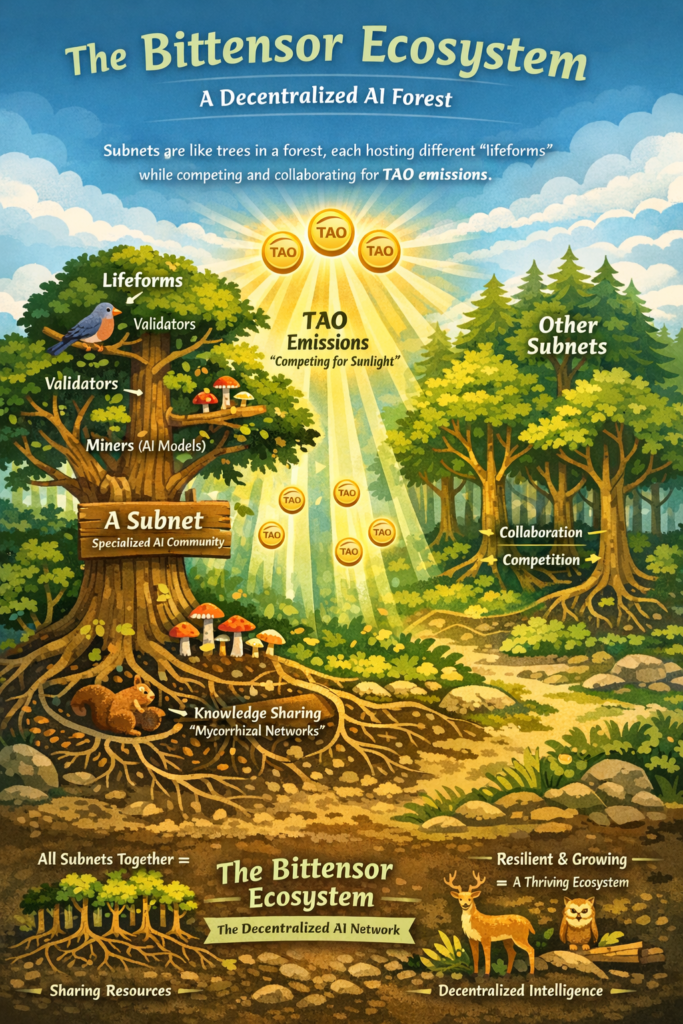
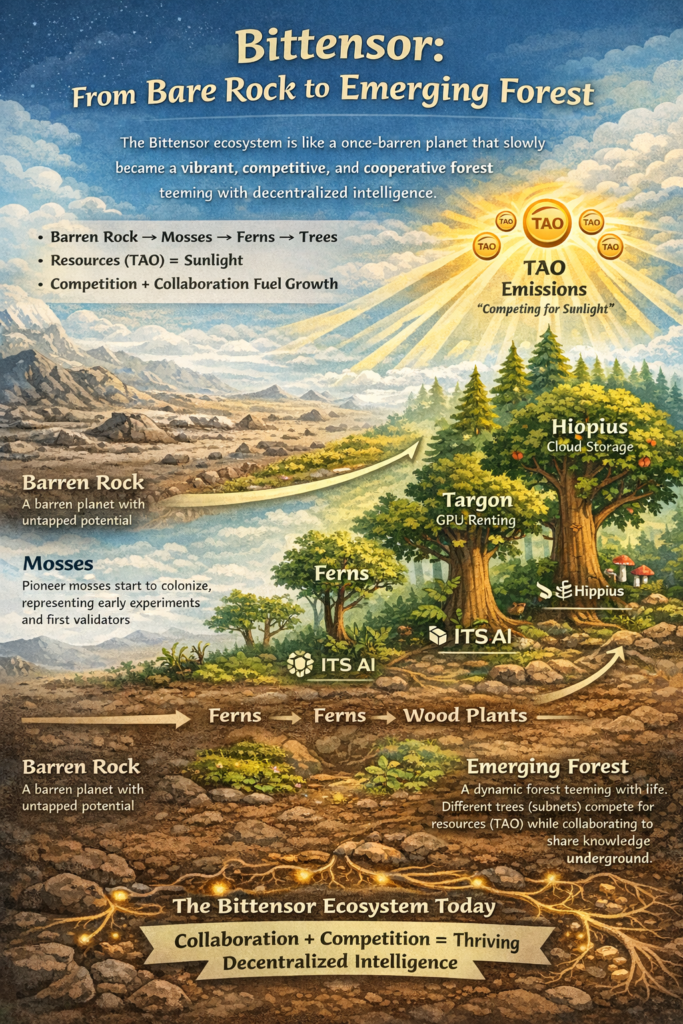
When I first encountered it, I saw something else. I saw an emerging new ecosystem or forest on a rocky planet. Not a product. Not a company. Not a dashboard. An ecosystem— with energy entering from outside, organisms competing for it, regulatory forces shaping behavior, and long-term survival determined by structure rather than intention.
That instinct comes from ecology. Ecology is the discipline of studying systems where nobody is in charge, yet order emerges. Where competition and cooperation coexist. Where survival depends less on good storytelling and more on whether energy flows are converted into durable structure.
Bittensor behaves like that. And once you see it that way, many confusing parts become obvious.
Energy: Sunlight and TAO
Every ecosystem begins with a constraint: energy.
Sunlight enters from outside the forest. There is only so much of it. Trees do not create sunlight. They compete for it. The tallest stretch into the canopy. Smaller ones grow in gaps. Some adapt to shade. Others disappear. The entire structure of the forest is shaped by this single fact: limited external energy.
Bittensor works the same way. TAO emissions enter the system at a fixed structural rhythm. Subnets do not invent this energy. They do not negotiate it. They position themselves to capture a share of it. TAO emissions function as sunlight inside this digital ecosystem. They are limited. They are external. And they define how much growth is even possible.
Converting Energy: Subnets as Primary Producers
But sunlight alone does not create a forest.
A tree must convert light into wood, roots, leaves, fruit. It must build structure. It must store energy. That stored energy allows it to survive storms and dry seasons. A tree that grows fast but builds weak wood looks impressive — until the first serious wind arrives.
Subnets face the same reality. Receiving emissions is not success. Converting emissions into durable intelligence is. That means:
- miners producing real output,
- validators performing credible evaluation,
- liquidity pools deep enough to reduce fragility and volatility in case of bad weather,
- capital that stays rather than speculates and leaves.
Under the flow-based emission model, subnets that attract sustained net TAO inflows receive more energy. Those with persistent negative flows can see emissions drop to zero.
If a subnet absorbs emissions without producing durable value, it becomes fragile. Fast growth without structural depth rarely survives maturity.
Competition for Light
In a forest, trees compete for light. The canopy thickens. Shade increases. Only those positioned well enough continue to grow.
In Bittensor, subnets compete for emission share. Flow-based emissions mean that sustained net capital inflows influence how much energy a subnet receives. If capital flows elsewhere, energy follows. If staking drains out, injection declines. In extreme cases, it stops.
This creates a dynamic similar to canopy competition. Some subnets accumulate deep liquidity and strong validator participation, reinforcing their position. Others struggle to reach sunlight.
Competition and specialization are not a flaw. They are the organizing forces of complex systems. They help explain why we have millions and millions of individual species of animals on planet Earth rather than just 3.
Trophic Structure: Miners, Validators, Stakers
Forests are not just trees. They are layered systems. Plants capture energy. Herbivores feed on plants. Carnivores regulate herbivores. Decomposers recycle nutrients. Each level depends on the one below.
Bittensor has its own trophic structure.
Energy enters through emissions. Within each subnet, emissions are distributed roughly across miners, validators, stakers, and subnet owners. Miners produce outputs. Validators evaluate those outputs. Stakers allocate capital, influencing which validators hold weight.
Higher layers cannot float independently.
Validators cannot earn sustainably without productive miners. Stakers cannot earn without validators performing real evaluation. Subnet owners cannot capture long-term value if the underlying intelligence is weak.
Energy flows upward through structure. And at every transfer, performance matters.
Regulation: Why Validators Matter
Remove predators (or let’s call them stabilizers) from a forest and herbivores multiply. They overgraze. Regeneration slows. The forest thins and the entire ecosystem destabilizes.
Predators are not villains. They are stabilizers.
In Bittensor, miners resemble herbivores. They consume emissions by competing for rewards. But their populations need to be controlled. Validators resemble regulatory predators. They determine which miner outputs are truly valuable and which miners should be removed from the system.
If validators fail in this regulatory role, emissions can be consumed without intelligence being strengthened. The system risks rewarding noise. Over time, that erodes structural integrity.
Ecosystem stability does not emerge from goodwill. It emerges from regulation that prevents overconsumption. Continuous regulation. This is exactly what validators do as well. They maintain the balance in the subnets and entire Bittensor ecosystem.
Niche Specialization
In nature, species survive by specializing. Two species occupying the exact same niche rarely coexist indefinitely. One outcompetes the other. Diversity arises when organisms differentiate — in diet, timing, habitat, function.
Bittensor encodes specialization at the subnet level.
Each subnet defines a unique task, its own incentive mechanism, and its own evaluation structure. Some focus on narrow AI commodities (like Yanez MIID). Others aim for broader use cases (like Chutes). Some may remain small but stable, serving niche demands. Others attempt to dominate wider terrain.
This reduces direct overlap and allows structural diversity.
Not every subnet needs to be the tallest tree. Some survive in the understory. Some adapt to specific conditions. The ecosystem becomes richer not because every participant wins, but because not every participant competes on identical terms.
Energy Storage: Liquidity as Biomass
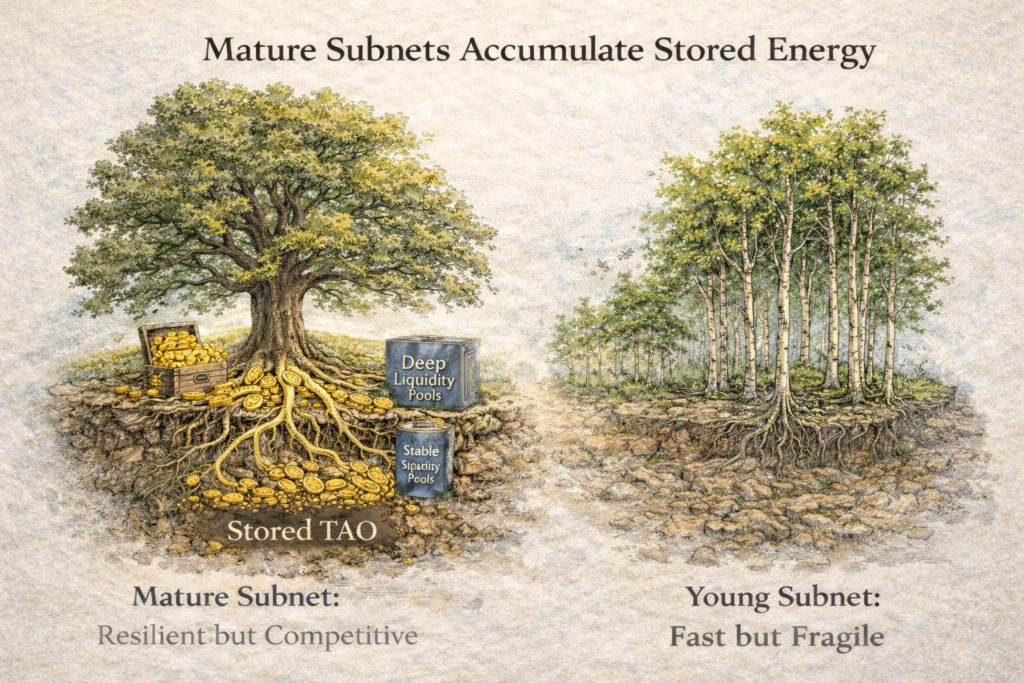
Mature forests do not only have flowing energy. They have stored energy.
Thick trunks. Deep roots. Rich soil. Biomass accumulated over years.
That stored energy creates resilience. It buffers drought. It slows collapse. It increases inertia.
In Bittensor, liquidity pools and long-term stake function similarly. TAO locked into pools, alpha held by stakers, root staking dynamics — these represent stored energy. Deep liquidity reduces slippage. Stable staking reduces volatility. Long-term capital creates structural weight.
Young subnets resemble fast-growing species like birch. They can grow very quickly but only require one small disturbance to get wiped out completely. Mature subnets resemble slower-growing hardy trees like beech or oak: slower but harder to displace.
Stored energy changes behavior. It makes the ecosystem less reactive and more stable — but also more competitive for newcomers trying to reach sunlight.
Keystone Effects
Some species exert influence far beyond their biomass. Remove them, and the ecosystem reorganizes.
Bittensor may contain similar structural centers (think of Chutes, Targon) — subnets whose liquidity depth, validator concentration, and emission dominance create disproportionate influence. Whether these are truly irreplaceable or simply early movers remains an open structural question.
Ecology teaches caution here. Dominance does not automatically equal permanence.
But structural centrality, if present, reshapes the entire system around it.
Succession and Halving
Early ecosystems grow fast. Pioneer species colonize quickly. Energy is abundant relative to competition. Instability is common.
Later ecosystems mature. Energy input may slow. Competition intensifies. Survival depends less on rapid expansion and more on durable structure.
Bittensor’s halving schedule acts as a succession driver.
As emissions decline over time, the energetic environment tightens. In high-emission phases, experimentation and expansion are easier. In lower-emission phases, competition intensifies. Capital must be retained. Utility must justify staking flows.
The system becomes less forgiving. In ecological terms: early growth rewards speed. Later survival rewards strength.
Bittensor is currently an early ecosystem with lots of fast-growing species and constantly-changing dynamics. However, this won’t last. I think that within a couple of years (or maybe even earlier) we will start to see the first signs of ecosystem maturation, with a more stable top 10 of subnets with reduced volatility.
Resilience and Fragility
Resilience in ecology means absorbing shocks without collapsing into a new state. It emerges from diversity, distributed control, and strong feedback mechanisms.
Bittensor attempts to engineer resilience through:
- stake-weighted consensus,
- majority trust thresholds,
- bond smoothing over time,
- pruning of low performers,
- emission penalties for sustained capital outflow.
These mechanisms do not guarantee stability. They create conditions under which stability can emerge — assuming the majority of stake behaves rationally and honestly enough to converge on useful evaluation.
Every ecosystem has fragility points.
The question is not whether fragility exists. The question is whether the feedback systems are strong enough to prevent collapse when stress arrives.
Why This Lens Clarifies Bittensor
Viewing Bittensor through an ecological lens does not romanticize it.
It clarifies it.
TAO emissions become sunlight rather than “rewards.”
Subnets become energy converters rather than “projects.”
Miners become consumers of energy rather than “nodes.”
Validators become regulatory forces rather than “operators.”
Liquidity becomes stored biomass rather than “TVL.”
Halvings become succession pressures rather than marketing events.
And once you see those structural roles clearly, the system stops looking chaotic.
It starts looking alive.
Not alive in a mystical sense.
Alive in the sense that it is governed by flows, competition, regulation, specialization, storage, and evolution.
In the end, this isn’t a static protocol to be understood once and filed away. It is an evolving system shaped by incentives, flows, and interaction. And like any ecosystem, it rewards those who understand its structure — not those who simply admire its surface.