
What Is the TAO Token?
The TAO token is the native cryptocurrency of the Bittensor network. It powers the economic system that coordinates miners, validators, and subnets. TAO is used for staking, securing the network, and routing incentives across the decentralized AI ecosystem.
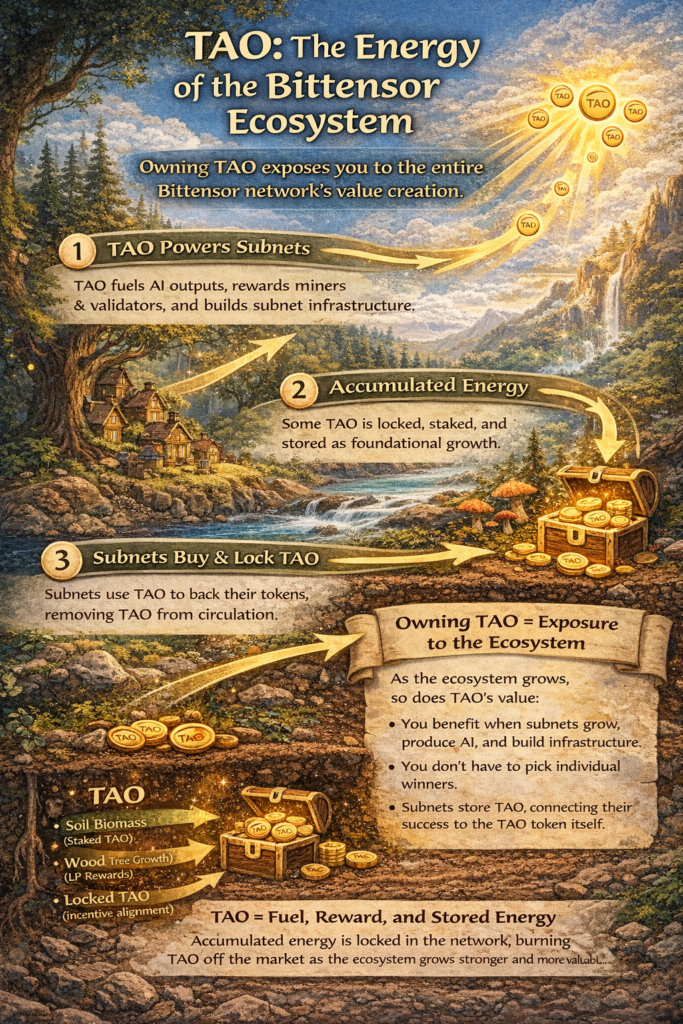
If Bittensor is a forest, TAO is its energy.
Without energy, forests don’t grow. Without TAO, Bittensor doesn’t function.
But “energy” in a forest means more than sunlight. It also means biomass — wood, leaves, roots, soil humus. Stored energy. Accumulated life. Long-term resilience.
TAO plays both roles.
It is the sunlight that powers daily activity.
And it is the biomass that stores long-term strength.
Understanding that dual role is the key to understanding the entire system.
TAO as Biomass: Stored Energy
Sunlight alone doesn’t create a resilient forest. Energy must be stored.
Trees convert sunlight into wood. Soil stores nutrients. Roots lock in long-term strength. That stored energy allows the forest to survive droughts, storms, and seasonal cycles.
TAO behaves similarly.
Not all TAO is immediately spent. Large amounts are staked. Liquidity pools lock TAO inside subnet economies. Long-term holders remove TAO from liquid circulation.
This is economic biomass.
When TAO is staked into subnets, it is no longer freely circulating. It becomes part of the ecosystem’s structural base. That reduction in liquid supply is not cosmetic. It changes the pressure dynamics of the entire system.
Less circulating TAO means:
Lower immediate selling pressure
Greater sensitivity to demand shifts
Stronger structural linkage between activity and scarcity
Storage strengthens the forest.
But only if the trees are healthy.
How Subnets Convert TAO into Infrastructure
In a forest, energy doesn’t sit idle. It is converted.
Sunlight becomes leaves. Leaves become fruit. Fruit becomes seeds. Wood becomes structure.
In Bittensor, TAO is converted into work.
Subnets use TAO emissions to:
Reward miners producing AI outputs
Incentivize validators to score performance accurately
Attract compute, storage, and infrastructure
Fund internal development
In other words, TAO becomes intelligence.
Not metaphorically. Economically.
TAO flows in. AI services, compute markets, storage networks, and detection systems emerge. The energy transforms into infrastructure.
That conversion is the core loop.
If TAO flows but no useful work is produced, the system weakens.
If useful work expands, the conversion strengthens the network.
Subnet Success and TAO Accumulation
Here’s where the architecture becomes more interesting.
Each subnet issues its own token. That token represents participation inside that subnet’s micro-economy. But those tokens are not independent islands.
Subnets want their token to hold value. To support that value, they often buy TAO from the open market and lock it into their subnet liquidity pools. This helps to maintain their own ‘local currency’ and is essential for their long term success.
Translate that back into the forest model:
Subnets take sunlight from the broader environment and convert it into stored biomass.
They remove TAO from circulation. They embed it into their local economy. They strengthen their own “soil.”
This creates a structural linkage.
As subnets succeed and attract real activity, they tend to accumulate and lock TAO. That reduces liquid supply and increases the amount of TAO embedded in productive ecosystems.
Subnet success does not automatically guarantee TAO appreciation. But it does mean that growth cannot bypass the base asset.
That’s a meaningful difference from many crypto systems.
TAO in the City Model
Now zoom out.
If the forest explains energy and storage, the city explains money.
In the city metaphor, TAO is the shared planetary currency.
Every city (subnet):
Pays workers (miners) in TAO
Attracts capital denominated in TAO
Competes for economic activity measured in TAO
Stores reserves in TAO
You don’t participate in Bittensor without touching TAO. It is the settlement layer between cities.
If a subnet grows, it must transact in TAO.
If a subnet wants to defend its token, it must acquire TAO.
If builders want to allocate capital, they must hold TAO.
TAO is not peripheral.
It is the accounting core.
How TAO Differs from a Traditional Stock
It’s tempting to compare TAO to equity in a company. That comparison only goes so far.
A stock represents ownership in a legal entity. It gives rights to future profits, governance participation, or residual claims.
TAO is different.
TAO does not represent ownership in a company. There is no CEO. No balance sheet. No quarterly earnings.
Instead, TAO represents participation in an open economic system.
Its value is not derived from corporate profits. It is derived from:
Scarcity (fixed supply)
Emission schedule (declining issuance over time)
Utility (required for staking and participation)
Structural demand from subnet economies
A stock captures cash flow.
TAO captures coordination.
The Critical Condition
TAO’s architecture is disciplined. But architecture alone is not enough.
For TAO to remain structurally relevant, three conditions must hold:
The measurement layer must reliably reward useful intelligence.
Subnets must generate sustained external demand.
Capital must continue to route through TAO rather than fragmenting away from it.
If those conditions hold, TAO functions like accumulated energy in a growing ecosystem. Scarcity amplifies usefulness. Storage strengthens resilience.
If they fail, TAO behaves like any other speculative asset — volatile, narrative-driven, disconnected from durable output.
The difference is not philosophical.
It is structural.
TAO is the energy of Bittensor.
But like any energy system, its long-term value depends entirely on what the ecosystem does with it.