
Understand Bittensor and TAO — without being an AI expert
Clear explanations of Bittensor’s architecture, incentives, and emerging AI economy. Written for curious people who want to understand the system without needing to be AI researchers or crypto insiders.

Why This Site Exists
I’m Niek, the founder of Discover Bittensor.
I got very curious about Bittensor in 2025 when I first came across it. After researching it for a couple of weeks, I realized what its true nature and potential are. And realized that if Bittensor succeeds, it will change the world radically and in a way not seen since Bitcoin.
However, when I first tried to understand Bittensor, it felt like walking into a city already under construction. Districts had names. People spoke in shorthand — emissions, validators, subnet liquidity — as if everyone had been present since the beginning.
I hadn’t. And I am sure that I’m not the only one.
I started Discover Bittensor to make Bittensor understandable for curious people who want to grasp how it works without needing to be AI researchers or crypto insiders. Bittensor’s biggest challenge is its technical complexity. This frightens normal people. However, I firmly believe Bittensor can be explained to ‘normal’ people without over complicating the technical side of it.
This site is my independent attempt to close that gap.
If I had to point to one article that captures the core ideas behind Bittensor, this would be it. It’s the most complete explanation I’ve written of how the system works and why it matters.
Navigation
New to Bittensor
Start with the fundamentals and understand how the system works.
Looking for deeper analysis
Explore content about the architecture, incentives, and economics of the network.
Subscribe to the Discover Bittensor Podcast
My attempt to help ‘normal’ people understand bittensor.
Learn the Basics
What is Bittensor?
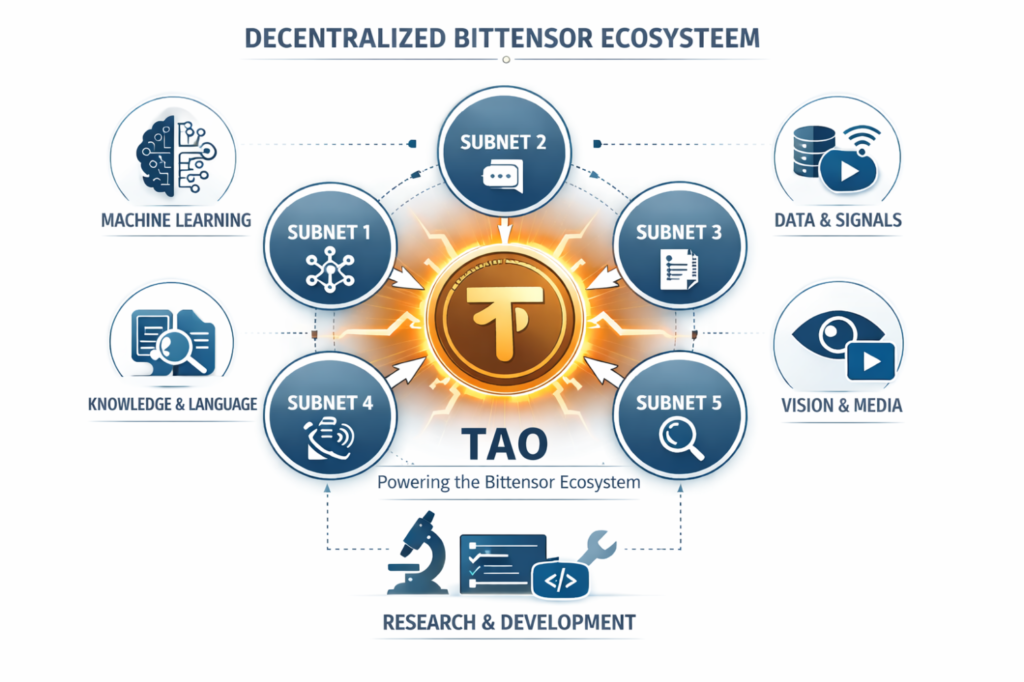
If I had to strip it down to something concrete, I’d describe Bittensor as a network of AI-focused startups — called subnets — operating inside a shared economic system.
Instead of one company building AI behind corporate firewalls, Bittensor attempts to coordinate intelligence production through open economic incentives.
What is TAO?
TAO is the base asset of the Bittensor network. It is not a decorative token layered on top of the system; it is the mechanism through which coordination happens.
Every subnet operates within an economy that routes through TAO, connecting performance, incentives, and capital.
Why Bittensor Matters
In the traditional AI model, development concentrates inside a small number of companies. Capital, compute, and talent gather behind corporate boundaries.
Bittensor proposes something different: coordinating intelligence production through open incentives rather than corporate employment structures.
Featured Articles
The Complete Guide to Bittensor
Most explanations of Bittensor start with technical mechanics. This article starts somewhere else.
Instead of beginning with emissions and validators, it looks at the bigger picture: a new economic system for producing machine intelligence. Think of Bittensor less as a protocol and more as an emerging world of specialized AI markets connected by a shared currency.
If you want a single article that brings the whole system into focus, this is the one.
Bittensor’s Superpower
If you’ve heard someone say Bittensor has an “asymmetric advantage,” you might have rolled your eyes. That’s a healthy reflex.
The interesting part isn’t the phrase. It’s the mechanism underneath it.
There’s a simple real-world comparison that makes the design intuitive in a few minutes. Once you see it, the incentive structure stops feeling abstract — and you can decide for yourself whether the asymmetry is real or just optimistic language.
Invisible Rails
What if in 10 years time, Bittensor powers a large part of decentralized AI applications and software, and most people using these applications have still never heard of Bittensor? Then Bittensor has succeeded! It has become the invisible rails of the decentralized AI economy, just like Linux has become the invisible rails of today’s software.
Subscribe to the Newsletter
From time to time, I share longer reflections on Bittensor’s architecture, incentives, and emerging subnet ecosystem.
These are not market updates or price predictions. They are attempts to think carefully about how the system evolves — where the design looks powerful, where the assumptions might fail, and what developments are worth paying attention to.
If you want to follow that thinking, you can subscribe below.
What is TAO?
TAO is the native token of the Bittensor network. Think of it as the “energy” that powers the ecosystem. It incentivizes contributors to build intelligence, train models, and provide useful work to the network.
What is Bittensor?
A: Bittensor is an open, decentralized network for artificial intelligence. Instead of one company owning the AI, many independent contributors (subnets) provide AI models, data, and services — all rewarded with TAO. It’s like a digital ecosystem where intelligence evolves over time.
What is a Miner?
In Bittensor, a miner is a participant who runs models, contributes computation, or does any other task that is set by a subnet owner and earns TAO tokens. Miners are like “workers” in the ecosystem — they process data, answer queries, and help the network grow.
What is a Validator?
Validators check the work done by miners. They make sure the network is accurate, fair, and trustworthy. Think of them as referees who ensure that the intelligence being built is high-quality.
What is a Subnet?
A subnet is a specialized enterprise/start-up/mini-ecosystem within Bittensor. Each subnet focuses on a specific type of intelligence or service, like natural language understanding, data verification, or inference. Subnets compete for TAO but also benefit from each other by using each others’ services (which tend to be cheaper & better than their centralized counterparts).
How is Bittensor different from OpenAI or Google?
Instead of a single company controlling all AI models and data, Bittensor is fully decentralized. Anyone with an internet connection can run a miner, contribute to subnets, and earn TAO — no need to be a corporate employee.
How can I participate?
All you need is a computer and internet connection. You can run a miner, join subnets, or become an investor (staker).
Why is this important?
Bittensor is creating a new, open layer for intelligence — just like the internet made information accessible or Bitcoin decentralized money. Anyone in the world can contribute, and the ecosystem evolves like a digital rainforest, turning TAO energy into intelligence.
Who created Bittensor?
Jacob Steeves and Ala Shaabana.
- Jacob Steeves: A former Google AI engineer with a background in machine learning and distributed systems.
- Ala Shaabana: Co-founder with a background in software engineering and blockchain technology.
How does Bittensor decide which AI models or services are actually “good”?
Through validators. Validators continuously test, compare, and rank miners based on the real usefulness of their outputs. If a miner’s model or service helps more, it earns more TAO. If it performs poorly or cheats, it earns less (or nothing).
This creates a powerful feedback loop: better performance → more rewards → more investment → even better performance. It’s natural selection for machine intelligence.
How is Bittensor’s tokenomics similar to Bitcoin?
Like Bitcoin, TAO has hard, programmatic issuance and no central authority controlling supply. New TAO is emitted as rewards for securing and improving the network — in Bittensor’s case, by producing valuable intelligence.
This means TAO isn’t just a speculative token: it’s the economic engine that pays for real work. Just as Bitcoin monetizes security and trust, TAO monetizes intelligence and usefulness.
What is the network effect in Bittensor?
The more miners, validators, and subnets that join, the more valuable the network becomes — and the more TAO is earned by everyone. Each new contributor adds intelligence, computation, or data, which benefits all other participants. This is similar to the internet: more users = more content = more value.
Why would a talented AI engineer choose Bittensor over a big tech job?
Because on Bittensor, you’re not limited by hiring committees, politics, or corporate roadmaps. You ship something useful, the network tests it, and you get paid based on impact, not credentials.
Some top miners already earn more than many engineers at centralized AI labs — but more importantly, they own their work, their infrastructure, and their upside. It’s open competition for intelligence, on a global stage.
Why can’t a centralized company eventually do this better or cheaper?
Because centralized systems hit natural limits:
They must pay fixed salaries instead of performance-based rewards
They can’t tap into global, permissionless competition
They carry massive overhead and coordination costs
They optimize for shareholders, not for open innovation
Bittensor, by contrast, turns the entire world into a continuous, incentive-driven R&D engine. The best solutions survive because they’re rewarded directly by the protocol. Over time, this outcompetes closed systems on both cost and innovation — not by ideology, but by economics.
How do the Bittensor tokenomics stimulate quality output?
TAO incentivizes good behavior and useful work. Miners are rewarded only when their models are accurate and valuable to the network. Validators ensure quality. Over time, this economic self-regulation drives the best models and services to the top — without a centralized manager.
Think of it as a digital ecosystem: energy (TAO) flows to the most productive lifeforms (subnets and miners), which drives the evolution of the network as a whole.
How is this different from other AI projects?
Most AI projects are centralized — controlled by companies or research labs. Bittensor is incentive-native, fully decentralized, and open to anyone. Early participants have a unique opportunity to shape the network, earn rewards, and help build a global intelligence ecosystem — just as early Bitcoin adopters helped build the decentralized money network.
What’s the real risk: why might Bittensor fail — and why is that also its strength?
The risk is that it’s messy, competitive, and chaotic. Some subnets will fail. Some ideas won’t work. Some teams will disappear.
But that’s also the point. Instead of betting everything on a few centralized labs, Bittensor lets thousands of approaches compete in the open. Failure is cheap. Success scales fast. Over time, this creates a system that adapts faster than any centrally planned AI strategy ever could. Exposure to the TAO token brings investors wide exposure to an ecosystem of AI start-ups.
If Bittensor succeeds, what changes for normal people — not just AI nerds?
AI becomes cheaper, more diverse, more transparent, and harder to monopolize. Instead of a few companies deciding what AI can do, you get a global marketplace of intelligences competing to serve you better.
Just like the internet broke the monopoly on information, and Bitcoin challenged the monopoly on money, Bittensor challenges the monopoly on who gets to build, own, and profit from intelligence.